
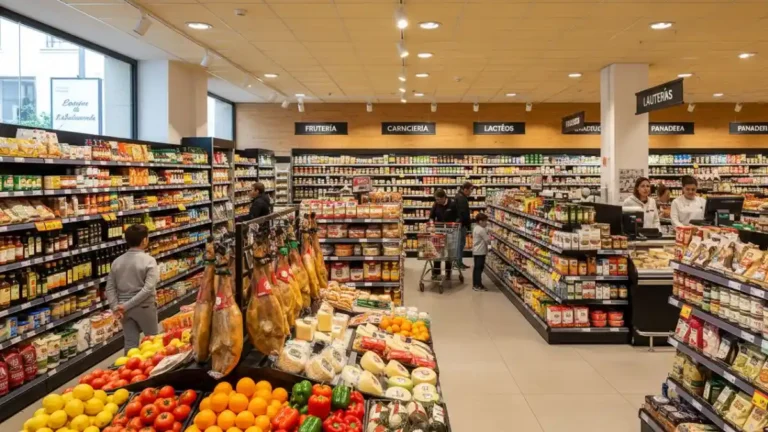

Spain’s grocery market is led by one dominant national operator. Below it sits a strong layer of regional cooperatives and purchasing alliances.
Revenue scale decides much of the market. It shapes supplier leverage, private label development, packaging negotiations and logistics investment.
The top 10 supermarkets in Spain by revenue in 2025 are:
- Mercadona
- Grupo IFA
- El Corte Inglés
- Eroski
- Grupo DIA
- Consum
- Ahorramas
- Bon Preu
- Covirán
- Uvesco
This ranking is based on the latest publicly available FY2024 financial disclosures. It includes Spain-headquartered operators only. Foreign-headquartered retailers such as Carrefour and Lidl are excluded.
Foreign-owned chains remain important competitors. Lidl’s Madrid store expansion adds selling space at an existing supermarket, rather than a new location.
Ranking Table (FY2024 Data)
| Rank | Company | FY2024 Revenue | Founded | Business Model | Employees |
|---|---|---|---|---|---|
| 1 | Mercadona | €38.8B+ | 1977 | Integrated national chain | 100,000+ |
| 2 | Grupo IFA | €16B+ (combined) | 1967 | Purchasing alliance | Alliance structure |
| 3 | El Corte Inglés | €13B+ (group) | 1940 | Department store + food retail | 80,000+ |
| 4 | Eroski | €5.7B+ | 1969 | Cooperative retail group | 27,000+ |
| 5 | Grupo DIA | ~€6B (Spain) | 1979 | Proximity discount chain | 20,000+ |
| 6 | Consum | €4.3B+ | 1975 | Cooperative supermarket chain | 19,000+ |
| 7 | Ahorramas | €2.4B+ | 1979 | Regional supermarket operator | 12,000+ |
| 8 | Bon Preu | €2.1B+ | 1974 | Catalan regional chain | 10,000+ |
| 9 | Covirán | €1.7B+ | 1961 | Retail cooperative network | 14,000+ |
| 10 | Uvesco | €1.5B+ | 1993 | Regional supermarket operator | 6,000+ |
Revenue figures reflect publicly reported fiscal data. Grupo IFA represents aggregated member turnover.
Ranking Criteria
This ranking evaluates:
- Spain-headquartered supermarket operators
- Latest available FY2024 revenue disclosures
- Grocery-focused revenue where reported
- Public financial statements and corporate reports
Grupo IFA operates as a purchasing alliance. It is included because its combined turnover exceeds several standalone operators.
No estimates or unofficial projections are used.
1. Mercadona
Founded in 1977 in Valencia, Mercadona is Spain’s largest supermarket operator by revenue and market share.
Core categories
- Fresh produce
- Meat and seafood
- Dairy
- Private label packaged grocery
- Household and personal care
Key facts
Revenue reached about €38.8 billion in FY2024.
Mercadona runs a vertically integrated supplier model known for long-term production partnerships. It keeps centralised logistics hubs and automated distribution centres.
Its scale gives it strong influence over packaging formats, supplier negotiations and national FMCG pricing structures.
2. Grupo IFA
Founded in 1967 in Madrid, Grupo IFA is Spain’s largest supermarket purchasing alliance.
Core functions
- Centralised procurement
- Private label sourcing
- Negotiated supplier contracts
- Distribution coordination across members
How the alliance works
Combined turnover exceeds €16 billion based on aggregated member revenue.
Grupo IFA does not run retail stores directly. Instead, it combines purchasing for more than 30 independent supermarket groups across Spain.
Its scale strengthens national negotiating leverage with FMCG manufacturers and packaging suppliers.
The alliance model lets regional chains compete with larger national operators. Members keep their local branding and operational independence.
Within Spain’s grocery structure, Grupo IFA works as a volume aggregation platform rather than a single retail banner.
3. El Corte Inglés (Supercor & Hipercor)
Founded in 1940, El Corte Inglés operates supermarkets and hypermarkets through its food division.
Food retail is a major part of its overall €13B+ group revenue.
Strength areas
- Urban supermarket presence
- Hypermarket format
- Premium private label categories
Its integrated retail model connects grocery with broader non-food retail operations.
4. Eroski
Founded in 1969 in the Basque Country, Eroski is one of Spain’s largest cooperative supermarket groups.
Core categories
- Fresh produce
- Bakery and meat counters
- Private label grocery
- Hypermarket and supermarket formats
Key facts
Revenue exceeded €5.7 billion in FY2024.
Eroski holds strong regional leadership in the Basque Country, Galicia and parts of northern Spain.
Its cooperative ownership shapes pricing discipline and long-term supplier relationships. This sets it apart from investor-led retail groups.
The company runs a consolidated logistics network. It supports fresh category differentiation and regional sourcing strategies.
Private label development remains central to margin stability in its core territories.
5. Grupo DIA
Founded in 1979 in Madrid, Grupo DIA operates one of Spain’s largest proximity-focused discount supermarket networks.
Core categories
- Discount grocery
- Private label packaged goods
- Neighbourhood supermarket formats
- Convenience and urban retail
Key facts
Spain revenue remains near €6 billion following restructuring and selective store disposals.
DIA’s model is built around smaller stores in residential and urban areas. This format strengthens local access and high-frequency shopping.
Private label penetration is central to its commercial position. It supports price competitiveness and margin control.
The company’s streamlined logistics network supports rapid replenishment and cost discipline in dense metropolitan zones.
6. Consum
Founded in 1975 in Valencia, Consum is one of Spain’s largest cooperative supermarket operators.
Core categories
- Fresh produce
- Meat and seafood counters
- Private label grocery
- Regional sourcing partnerships
Key facts
Revenue exceeded €4.3 billion in FY2024.
Consum continues to expand across eastern and Mediterranean Spain. It is growing its regional footprint through new store openings and network modernisation.
The cooperative ownership structure supports long-term supplier relationships and operational stability.
The company invests significantly in automated logistics platforms and cold-chain infrastructure. This improves efficiency in fresh and perishable categories.
Consum’s scale makes it one of the most structurally resilient regional operators in Spain’s grocery market.
7. Ahorramas
Founded in 1979 in Madrid, Ahorramas operates a regional supermarket network concentrated in the Madrid metropolitan area.
Core categories
- Fresh produce
- Meat and fish counters
- Private label grocery
- Supermarket-format retail
Key facts
Revenue exceeds €2.4 billion in FY2024.
Its geographic footprint is limited. Even so, Ahorramas achieves high sales per square metre and performs strongly in fresh categories.
Its concentrated logistics structure supports efficiency within a tightly defined regional market. This helps it compete against national chains in the capital region.
8. Bon Preu Group
Founded in 1974 in Catalonia, Bon Preu operates the Bonpreu and Esclat supermarket banners across the region.
Core categories
- Supermarket and large-format retail
- Fresh produce and meat counters
- Private label grocery
- Fuel retail integration
Key facts
Revenue exceeds €2.1 billion in FY2024.
Bon Preu is one of the dominant regional operators in Catalonia. It has strong brand loyalty and local sourcing partnerships.
The company continues to invest in store modernisation, energy efficiency and logistics improvements. These strengthen operational control within its core territory.
Its regional scale lets it balance local differentiation with structured procurement leverage.
9. Covirán
Established in 1961 in Granada, Covirán is a cooperative network of independent neighbourhood supermarkets across Spain.
Core functions
- Centralised procurement
- Private label sourcing
- Distribution and logistics support
- Retail services for independent operators
Key facts
Revenue approaches €1.7 billion in FY2024.
Covirán gives small and medium-sized retailers access to national purchasing scale. Members keep independent ownership and local branding.
Its cooperative structure strengthens supply chain coordination for rural and small-town grocery markets.
The model supports independent stores in an increasingly consolidated retail environment.
10. Uvesco (BM Supermercados)
Founded in 1993 in the Basque Country, Uvesco operates BM Supermercados across northern Spain.
Core categories
- Fresh produce
- Meat and fish counters
- Private label grocery
- Supermarket-format retail
Key facts
Revenue exceeds €1.5 billion in FY2024.
Uvesco has a strong regional presence in the Basque Country, Navarra and surrounding northern territories. Its model stresses fresh category differentiation and local supplier integration.
The company competes closely with other regional operators for the final top-10 places. Its position depends on fiscal year performance and comparative revenue disclosures.
Market Structure Analysis
Spain’s grocery market shows a dual structure:
- One dominant national leader
- Strong regional operators
- A powerful purchasing alliance model
Private label penetration remains structurally high, often exceeding 40% of FMCG value sales.
Revenue scale directly influences packaging decisions, supplier cost negotiations and logistics automation investment.
Regional chains stay resilient through proximity formats and strong local sourcing strategies.
Industry Direction
Spain’s supermarket sector is entering a phase defined by operational discipline and infrastructure investment.
Distribution automation continues to expand. Leading operators are modernising logistics hubs to:
- improve efficiency
- reduce labour intensity
- speed up replenishment across fresh and ambient categories
Energy efficiency investment is also accelerating. Retailers are upgrading refrigeration systems, warehouse insulation and store energy management platforms. This helps them manage rising utility costs and regulatory pressure.
Fresh categories remain central to traffic and competitive differentiation. Meat, produce and bakery counters continue to anchor store visits in both national and regional chains.
Revenue concentration among the largest operators is reinforcing negotiating leverage across the FMCG supply chain. This is most visible in private label production and packaging procurement.
Competition remains intense across formats and regions. Even so, the Spanish supermarket market is becoming increasingly consolidated at the top. Scale plays a decisive role in supplier negotiations and long-term logistics planning.
Frequently Asked Questions
What is the largest supermarket in Spain by revenue?
Mercadona is Spain’s largest supermarket operator by revenue and market share. Its revenue reached about €38.8 billion in FY2024.
Why are Carrefour and Lidl not in this ranking?
The ranking includes Spain-headquartered operators only. Foreign-headquartered retailers such as Carrefour and Lidl are excluded.
How high is private label share in Spain?
Private label penetration remains structurally high in Spain. It often exceeds 40% of FMCG value sales.
Conclusion
The ranking of the top supermarkets in Spain by revenue reflects a market shaped by national scale and regional resilience within the broader Spain FMCG landscape.
Mercadona remains structurally dominant. Cooperative and regional chains continue to reinforce local market strength across Spain.
Purchasing alliances combine significant negotiating power without unified branding. This creates layered competition inside the Spanish grocery system.
Revenue concentration at the top will keep shaping supplier relationships and Spain packaging procurement through 2026. The effect will be strongest in private label production and fresh category sourcing.
Scale, logistics control and operational efficiency will remain decisive in how the Spain retail market evolves over the coming year.
Editor’s Note: All revenue figures are based on publicly available FY2024–FY2025 corporate financial disclosures and annual reports. No currency conversions were required. Grupo IFA figures reflect combined member turnover as publicly reported.








