
Japan’s supermarket sector runs on tight margins, limited labour and dense urban store formats.
This has pushed grocery retailers to invest heavily in operational technology. Not experimental tools. Not showcase innovation.
Instead, they want practical systems that:
- keep stores running
- reduce labour pressure
- improve availability
- stabilise supply chains
Several technologies now form the backbone of supermarket operations across the country:
- POS infrastructure
- self-checkout platforms
- automated ordering
- cash handling systems
- distribution automation
This report ranks the top Japan supermarket technology companies. The ranking is based on operational relevance to grocery retail, domestic deployment footprint and FY2024–FY2025 business scale.
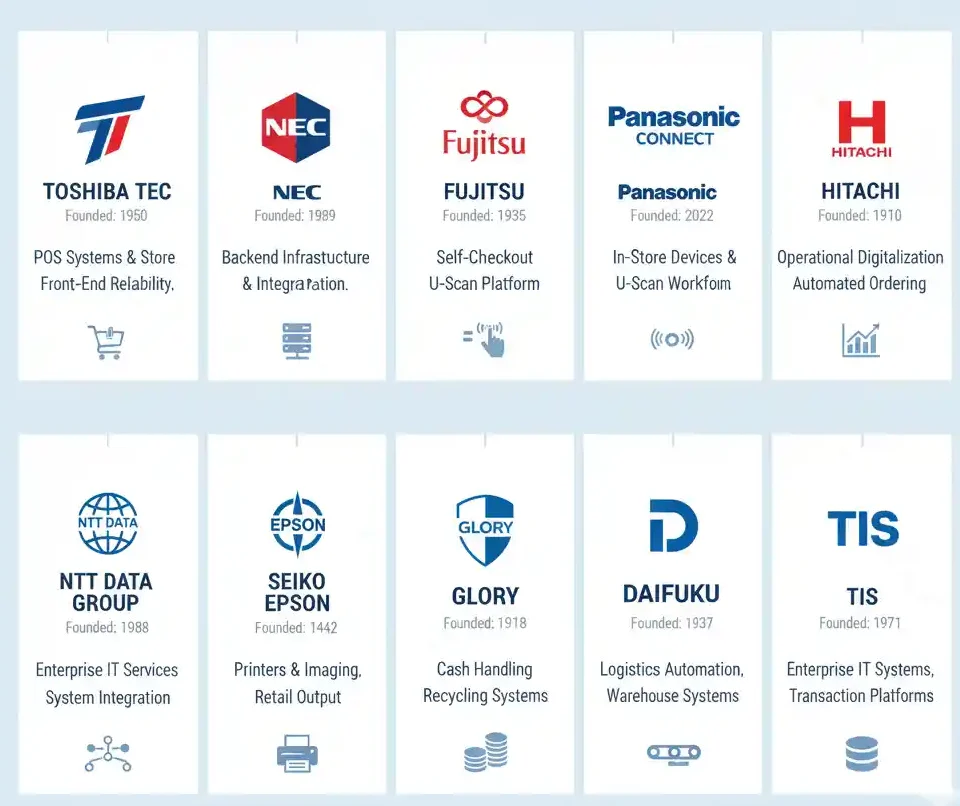
Top 10 ranking table
Revenue figures reflect latest publicly available FY2024–FY2025 group reporting where retail technology is part of wider business segments.
| Rank | Company | Founded | Core supermarket technology focus |
|---|---|---|---|
| 1 | Toshiba Tec | 1950 | POS platforms, checkout systems, store solutions |
| 2 | NEC | 1899 | retail IT platforms, systems integration |
| 3 | Fujitsu | 1935 | self-checkout software, store systems |
| 4 | Panasonic Connect | 2022 | in-store devices, operational technology |
| 5 | Hitachi | 1910 | automated ordering, retail DX systems |
| 6 | NTT DATA Group | 1988 | retail IT platforms, cloud integration |
| 7 | Seiko Epson | 1942 | POS printers, receipt and label printing |
| 8 | GLORY | 1918 | cash handling, cash recycling systems |
| 9 | Daifuku | 1937 | distribution automation, logistics systems |
| 10 | TIS (TIS INTEC Group) | 1971 | retail IT systems, transaction platforms |
Toshiba Tec
Founded: 1950
Toshiba Tec is one of the few Japanese technology companies where retail systems are not a side business.
What it supplies
The company’s core strength is POS infrastructure and store execution platforms. Its checkout hardware and retail software are used across large supermarket estates, convenience formats and food retail chains.
Why it matters to supermarket buyers
For grocery operators, Toshiba Tec is closely tied to front-end reliability.
Scanning speed, payment stability and integration with loyalty and accounting systems are central to store performance. That makes long lifecycle support and predictable rollout more important than headline innovation.
Recent corporate restructuring has focused on strengthening profitability and sharpening segment focus. For supermarket customers, this signals continuity in platform support rather than short-term product experiments.
NEC
Founded: 1899
NEC remains one of Japan’s most established enterprise technology suppliers.
What it supplies
NEC is not a pure retail technology company, but it plays a critical role behind supermarket operations. Large grocery groups depend on experienced domestic suppliers for:
- network infrastructure
- systems integration
- security layers
- platform stability
Why it matters to supermarket buyers
Supermarket technology increasingly depends on backend reliability. Payment systems, store servers, warehouse connectivity and head office integration must run without disruption during peak trading hours.
NEC’s scale and domestic enterprise presence let it operate at this infrastructure layer. It supports multi-store supermarket groups that need national deployment capacity and long-term system governance.
Fujitsu
Founded: 1935
Fujitsu has become one of the most visible self-checkout technology providers in Japan.
What it supplies
Its U-Scan platform supports self-service lanes used across grocery retail. The platform’s strength lies not only in hardware compatibility. It also lies in software stability, queue management logic and exception handling workflows.
Why it matters to supermarket buyers
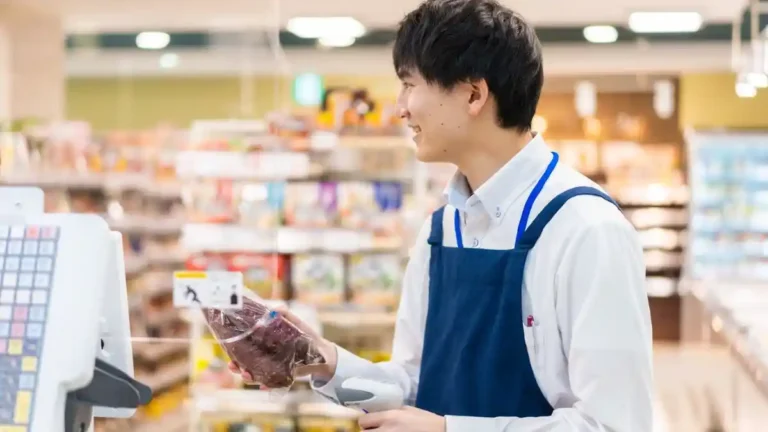
Japanese supermarkets face rising labour costs and persistent staff shortages. Self-checkout is now a standard operational tool rather than a premium feature.
Fujitsu’s positioning reflects this shift. The company treats self-checkout as core retail infrastructure. It is designed to integrate with existing POS environments and evolve alongside store format changes.
Panasonic Connect
Founded: 2022 (operating company structure)
Panasonic Connect focuses on frontline operational technology within Panasonic Group’s business portfolio.
What it supplies
Its relevance to supermarkets lies in in-store devices, authentication systems, sensors and operational workflow tools. These support tasks such as loss prevention, staff coordination and operational visibility.
Panasonic Connect does not sell retail software platforms directly. Instead, it contributes hardware and operational components that fit into larger supermarket technology ecosystems.
Why it matters to supermarket buyers
Retailers are redesigning store processes to reduce friction and manual handling. As they do, these supporting systems are becoming part of everyday operations rather than optional upgrades.
Hitachi
Founded: 1910
Hitachi’s supermarket relevance comes from operational digitalisation rather than consumer-facing systems.
What it supplies
The company has developed automated ordering and demand forecasting platforms. These are used to stabilise replenishment workflows. The systems aim to:
- reduce manual ordering work
- improve forecast accuracy
- lower waste across fresh and packaged categories
Why it matters to supermarket buyers
Ordering automation is not highly visible in stores. But it has a direct impact on margin performance and shelf availability.
Hitachi positions these systems as part of retail digital transformation. Its focus is operational efficiency rather than experimentation.
NTT DATA Group
Founded: 1988
NTT DATA is a major enterprise IT services provider with strong domestic retail system delivery capability.
What it supplies
For supermarkets, NTT DATA often acts as the integration layer. It connects several systems into a working retail ecosystem:
- POS platforms
- loyalty programs
- e-commerce operations
- accounting systems
- logistics platforms
Why it matters to supermarket buyers
Large grocery groups increasingly need long-term transformation partners rather than individual software vendors. System consolidation, cloud migration and operational standardisation projects are now multi-year programs.
NTT DATA’s strength lies in delivering and maintaining these complex environments at scale.
Seiko Epson
Founded: 1942
Epson’s role in supermarket technology is practical and operational.
What it supplies
Receipt printers, label printers and back-of-house printing equipment remain essential in grocery stores. Despite digitalisation, physical output still supports compliance, logistics labelling, shelf operations and checkout workflows.
Why it matters to supermarket buyers
Printer reliability is directly tied to store uptime. When hardware fails, checkout lanes slow down or close.
Epson continues to supply these critical components. This keeps it embedded in daily store operations without positioning itself as a full retail software provider.
GLORY
Founded: 1918
GLORY specialises in cash handling technology.
What it supplies
Cash recycling systems remain widely used in Japanese supermarkets, even as cashless payments grow. These systems:
- reduce staff handling time
- improve cash availability at tills
- lower error risk
GLORY’s machines are commonly built into both staffed checkout lanes and self-service areas.
Why it matters to supermarket buyers
For supermarket operators, cash handling automation improves labour efficiency and operational control. It also supports mixed payment behaviour across different customer groups.
Daifuku
Founded: 1937
Daifuku is one of Japan’s strongest logistics automation providers.
What it supplies
Its supermarket relevance comes from:
- distribution centre automation
- warehouse handling systems
- sorting equipment
- cold chain logistics infrastructure
Why it matters to supermarket buyers
Grocery retailers are pushing for faster delivery cycles and tighter inventory control. As a result, automation investment in distribution networks has increased.
Daifuku’s systems support high-volume food logistics. They help retailers reduce manual handling and stabilise fulfilment performance.
For supermarket groups, logistics automation is becoming a strategic asset rather than a back-office function.
TIS (TIS INTEC Group)
Founded: 1971
TIS provides enterprise IT systems used across retail and transaction-heavy industries.
What it supplies
Its supermarket role includes transaction platforms, retail system development and data integration projects.
Why it matters to supermarket buyers
Large grocery operators rely on stable transaction processing, reporting systems and backend integration. These support store networks, promotions and supplier settlements.
TIS focuses on long-term system delivery rather than short-term application rollouts. This matches supermarket needs for platform continuity.
Market structure impact
Japan’s supermarket technology market is shaped by stability requirements.
Retailers prioritise long lifecycle platforms, domestic support capability and operational reliability. Systems that fail during peak hours or need constant retraining are quickly replaced.
This favours companies with strong domestic delivery teams, service networks and integration expertise.
It also explains why large Japanese technology groups remain influential in grocery retail. This holds even when global software vendors compete in niche categories.
Category dominance trends
Three technology categories currently dominate supermarket investment.
Checkout automation and labour substitution
Self-checkout expansion continues. It is driven by labour shortages and customer acceptance of self-service workflows.
Ordering and replenishment automation
Forecasting systems and automated ordering tools reduce waste and manual labour while improving shelf availability.
Distribution and logistics automation
Warehouse automation and fulfilment efficiency are becoming competitive differentiators. This applies to supermarket groups running national store networks.
Structural outlook
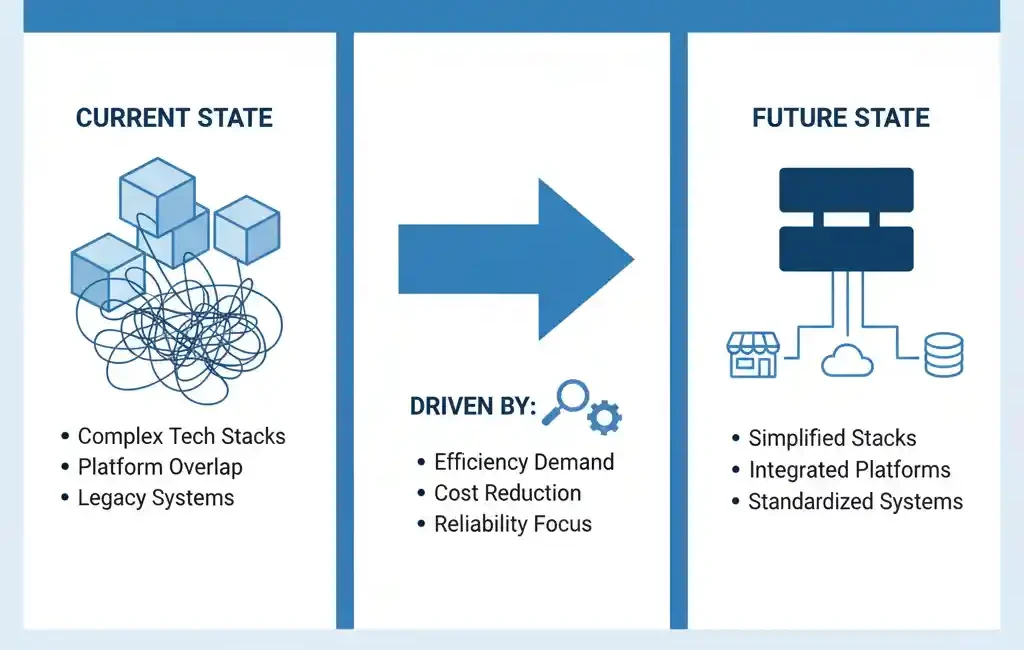
The next phase of supermarket technology in Japan is consolidation.
Retailers are simplifying their technology stacks. They are:
- reducing platform overlap
- standardising store systems
- retiring legacy infrastructure
This shift favours companies that can provide long-term operational support, scalable integration and predictable performance.
Technology suppliers that cannot deliver stable, low-disruption deployments will struggle to keep supermarket contracts in the next refresh cycle.
Frequently Asked Questions
Which company ranks first among Japan supermarket technology companies?
Toshiba Tec ranks first. Founded in 1950, it focuses on POS platforms, checkout systems and store solutions.
Who provides self-checkout technology to Japanese supermarkets?
Fujitsu is one of the most visible self-checkout providers in Japan. Its U-Scan platform supports self-service lanes across grocery retail.
Which technology categories dominate supermarket investment in Japan?
Three categories lead: checkout automation and labour substitution, ordering and replenishment automation, and distribution and logistics automation.
Conclusion
Japan’s supermarket technology landscape is moving away from pilot projects and toward operational infrastructure.
The ten companies ranked here form the backbone of grocery retail operations across checkout, ordering, logistics and store execution.
Over the next three years, competitive advantage will not come from flashy innovation. It will come from reliability, integration strength and the ability to simplify complex retail operations at scale.
That is where Japan supermarket technology companies will continue to be measured.
Editor’s Note: This report is based on publicly available company financial disclosures, corporate reporting materials, and official business segment information from FY2024–FY2025. No currency conversion has been applied unless explicitly stated.