
The 10 largest fresh produce companies in Canada in 2026 are:
- Mastronardi Produce
- Nature Fresh Farms
- Windset Farms
- Pure Flavor
- Village Farms International
- Red Sun Farms
- Star Produce
- Burnac Produce
- Topline Farms
- Del Fresco Pure
Canada’s fresh produce landscape in 2026 is defined by greenhouse scale, cold-chain discipline and concentrated retail buying power.
Ontario’s Essex County corridor and British Columbia’s Lower Mainland anchor domestic production. Around those clusters sit distribution and wholesale groups. They move high volumes through national retail networks.
This ranking focuses strictly on:
- Companies headquartered in Canada
- Majority Canadian-owned
- Active primarily in fresh fruit and vegetables
- Operating at meaningful commercial scale
Companies controlled by foreign multinationals are excluded, even if headquartered in Canada. That distinction reshapes the top tier.
The 2026 M&A Landscape: This ranking reflects a significant consolidation in Canadian agriculture.
Notably, Mucci Farms was historically a top-three Canadian player. It is now a subsidiary of the US-based Cox Farms (part of Cox Enterprises) following their 2024 acquisition.
Similarly, The Oppenheimer Group (Oppy) and Gambles Produce are excluded from this list. This is due to significant equity stakes held by foreign multinationals T&G Global and Dole plc, respectively.
This focus highlights the independent, family-led and publicly traded Canadian firms that anchor the nation’s domestic food security.
10 Largest Majority Canadian-Owned Fresh Produce Companies (2026)
| Rank | Company | HQ | Est. 2026 Revenue (CAD) | Primary Role |
| 1 | Mastronardi Produce | Kingsville, ON | $2.5B+ | Global Greenhouse Leader |
| 2 | Nature Fresh Farms | Leamington, ON | $700M – $900M | Integrated GH Grower |
| 3 | Windset Farms | Delta, BC | $650M – $850M | Western Canada Anchor |
| 4 | Pure Flavor | Leamington, ON | $550M – $750M | Specialty Snacking |
| 5 | Village Farms Int. | Delta, BC | $450M – $650M | High-Tech Produce/CBD |
| 6 | Red Sun Farms | Kingsville, ON | $400M – $550M | 800+ Acre Operator |
| 7 | Star Produce | Calgary, AB | $350M – $450M | Western Distribution |
| 8 | Burnac Produce | Toronto, ON | $250M – $350M | Logistics & Cold-Chain |
| 9 | Topline Farms | Leamington, ON | $200M – $300M | High-Volume Supply |
| 10 | Del Fresco Pure | Kingsville, ON | $150M – $250M | Specialty Greenhouse |
Revenue figures for private firms are directional estimates. They are based on footprint, acreage, industry benchmarking and scale comparisons. Not audited disclosures.
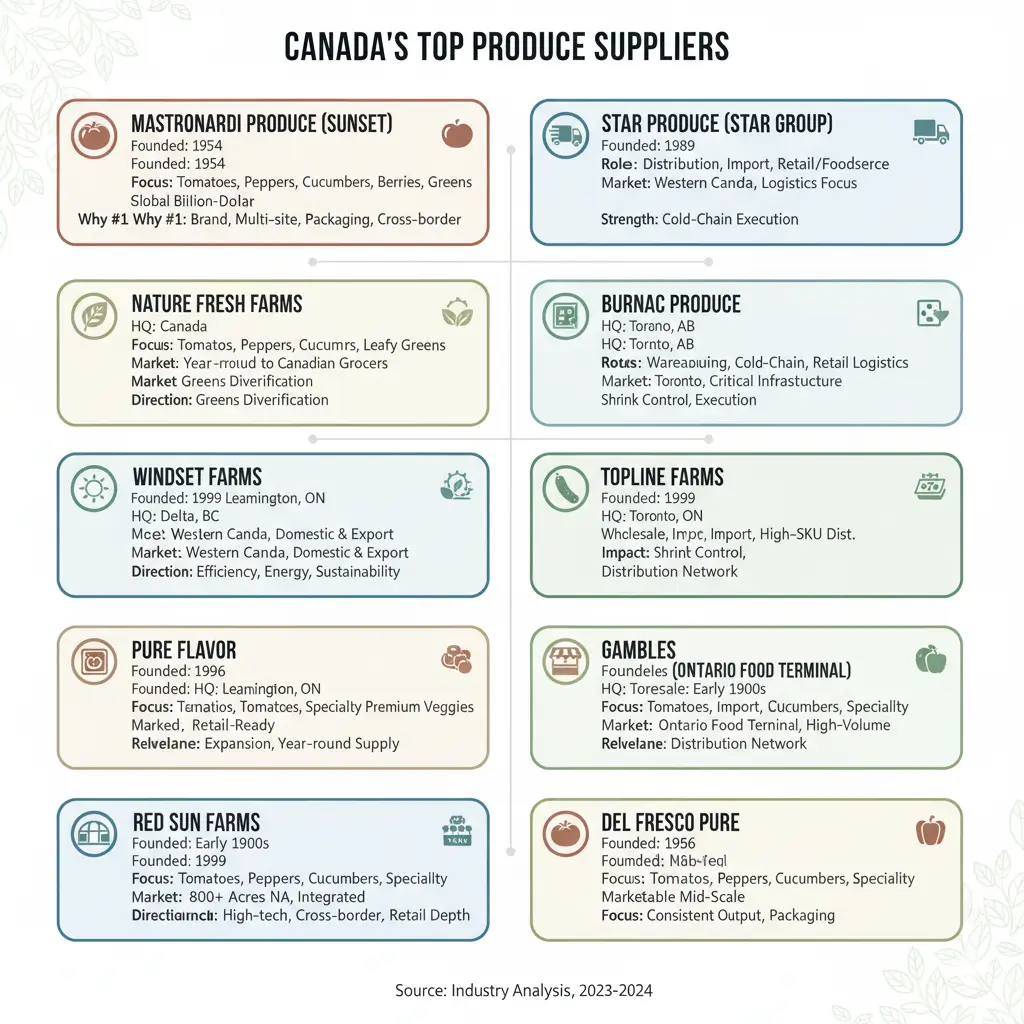
1) Mastronardi Produce (SUNSET)
Founded in 1954, Mastronardi Produce remains the largest majority Canadian-owned greenhouse platform headquartered in Canada.
Core Categories
- Tomatoes (core + specialty)
- Peppers
- Cucumbers
- Expanding berry and greenhouse greens programs
Scale: The company operates across North America. It is widely regarded as a billion-dollar greenhouse enterprise globally.
Why 1
Mastronardi combines:
- Brand platforms
- Multi-site production
- Retail-ready packaging
- Cross-border continuity
It sets the commercial standard for Canadian-controlled greenhouse supply.
Latest Direction: Expansion into berries and greens signals diversification beyond the traditional greenhouse trio.
2) Nature Fresh Farms
Founded: 1999
Headquarters: Leamington, Ontario
Nature Fresh Farms has grown into one of Canada’s most vertically integrated greenhouse suppliers. It operates from the core of Ontario’s production corridor.
Core Categories
- Tomatoes
- Peppers
- Cucumbers
- Expanding leafy greens
Market Position
Nature Fresh has significant greenhouse acreage in Ontario and a broader North American production footprint. This lets it support stable, year-round retail programs for grocery stores in Canada.
Latest Direction
Its expansion into leafy greens signals gradual category diversification beyond core greenhouse vegetables. This matches retailer demand for broader perimeter offerings.
3) Windset Farms
Founded: 1996
Headquarters: Delta, British Columbia
Windset Farms is a major greenhouse producer anchored in Western Canada. Its operations support both domestic and export markets.
Core Categories
- Tomatoes
- Peppers
- Cucumbers
- Specialty greenhouse formats
Market Position
Windset plays a stabilising role in Western supply. Being close to production helps reduce transport volatility and improve delivery consistency for grocery stores in Canada.
Latest Direction
Ongoing investment in greenhouse efficiency, energy management and sustainability systems reflects rising cost and compliance pressures. These pressures are shaping controlled-environment agriculture.
4) Pure Flavor
Founded: 2003
Headquarters: Leamington, Ontario
Pure Flavor has built its greenhouse platform around branded, retail-ready produce formats rather than bulk commodity supply.
Core Categories
- Snacking tomatoes
- Specialty peppers
- Premium greenhouse vegetables
Market Position
Pure Flavor competes in higher-margin greenhouse segments. It supplies differentiated formats to grocery stores in Canada and export markets.
Its focus on packaging, branding and consistent greenhouse output supports structured retail programs.
Latest Direction
Recent greenhouse expansion into more production regions has strengthened year-round continuity. It has also reduced seasonal supply gaps for retail partners.
5) Village Farms International
Founded: 1987
Headquarters: Delta, British Columbia
Village Farms is one of the longest-tenured and most technologically advanced greenhouse operators in Canada.
Core Categories
- Beefsteak and Specialty Tomatoes
- Cucumbers and Peppers
- Cannabis and CBD (via Pure Sunfarms)
Market Position
Many competitors have stayed strictly in produce. Village Farms (TSX: VFF) is unique for its “dual-engine” model.
It remains a core supplier of fresh vegetables to national grocery stores in Canada. At the same time, it is converting significant acreage in Delta, BC, to high-margin cannabis production.
Latest Direction
In 2025–2026, Village Farms completed a strategic “privatization” of its fresh produce segment into a joint venture (Vanguard Food LP).
This lets it focus on global export markets while keeping its status as a Canadian-controlled agricultural leader.
6) Red Sun Farms
Founded in 1996 and headquartered in Kingsville, Ontario.
Red Sun Farms is one of the most significant greenhouse operators in North America. It is also a long-running Platinum Club member of Canada’s Best Managed Companies.
Core Categories
- Tomatoes
- Peppers
- Cucumbers
- Specialty greenhouse items
Scale Indicators
- Over 800 acres across North America
- Vertically integrated growing and marketing
- Presence across major Canadian retailers
Why It Belongs
Red Sun combines:
- High-tech greenhouse scale
- Cross-border continuity
- Retail program depth
Its acreage and integration place it firmly in the top tier of Canadian-controlled produce suppliers.
7) Star Produce (Star Group)
Founded: 1989
Headquarters: Calgary, Alberta
Star Produce is one of the leading fresh produce distribution platforms in Western Canada.
Core Role
- Full-line produce distribution
- Import coordination
- Retail and foodservice supply
Market Position
Star has major refrigerated hubs in Calgary and Vancouver. It supports grocery stores in Canada across Alberta and British Columbia.
Its distribution scale is especially important in Western markets. There, long transport lanes and seasonal import reliance require disciplined cold-chain execution.
Star’s strength lies in logistics integration and consistent program delivery rather than greenhouse production.
8) Burnac Produce
Headquarters: Toronto, Ontario
Burnac Produce is a Toronto-based, family-owned logistics and storage operator. It has long-standing involvement in Canada’s fresh produce supply chain.
Core Capabilities
- Refrigerated warehousing
- Cold-chain management
- Retail logistics coordination
Market Position
Burnac plays a behind-the-scenes but critical role in supporting grocery stores in Canada. It does this through temperature-controlled storage and distribution infrastructure.
Its refrigerated footprint helps maintain product integrity across long transport lanes.
Cold-chain discipline remains central to shrink control, compliance standards and overall retailer profitability in fresh produce.
9) Topline Farms
Founded: 1999
Headquarters: Leamington, Ontario
Topline Farms operates within Ontario’s core greenhouse production corridor. It focuses on high-volume vegetable programs.
Core Categories
- Tomatoes
- Cucumbers
- Peppers
Market Position
Topline is recognised as a steady greenhouse supplier. It serves grocery stores in Canada through consistent year-round output.
Its location within the Leamington cluster supports efficient packing, logistics and integration into national retail programs.
Topline is not positioned as a branded leader. It stays relevant through dependable volume and disciplined greenhouse production.
10) Del Fresco Pure
Founded: 1956
Headquarters: Kingsville and Leamington, Ontario
Del Fresco Pure is one of Ontario’s long-standing greenhouse operators. It has nearly seven decades of controlled-environment production experience.
Core Categories
- Greenhouse tomatoes
- Peppers
- Cucumbers
- Specialty varieties
Market Position
Del Fresco operates within the Essex County greenhouse corridor. It maintains steady supply relationships with grocery stores in Canada, especially in core vegetable categories and select premium formats.
Operational Relevance
The company focuses on:
- Consistent year-round greenhouse output
- Retail-ready packaging
- Specialty differentiation within mainstream categories
Del Fresco is smaller than the top greenhouse platforms. It remains a stable mid-scale supplier within the majority Canadian-owned segment.
Structural Market Insights for 2026
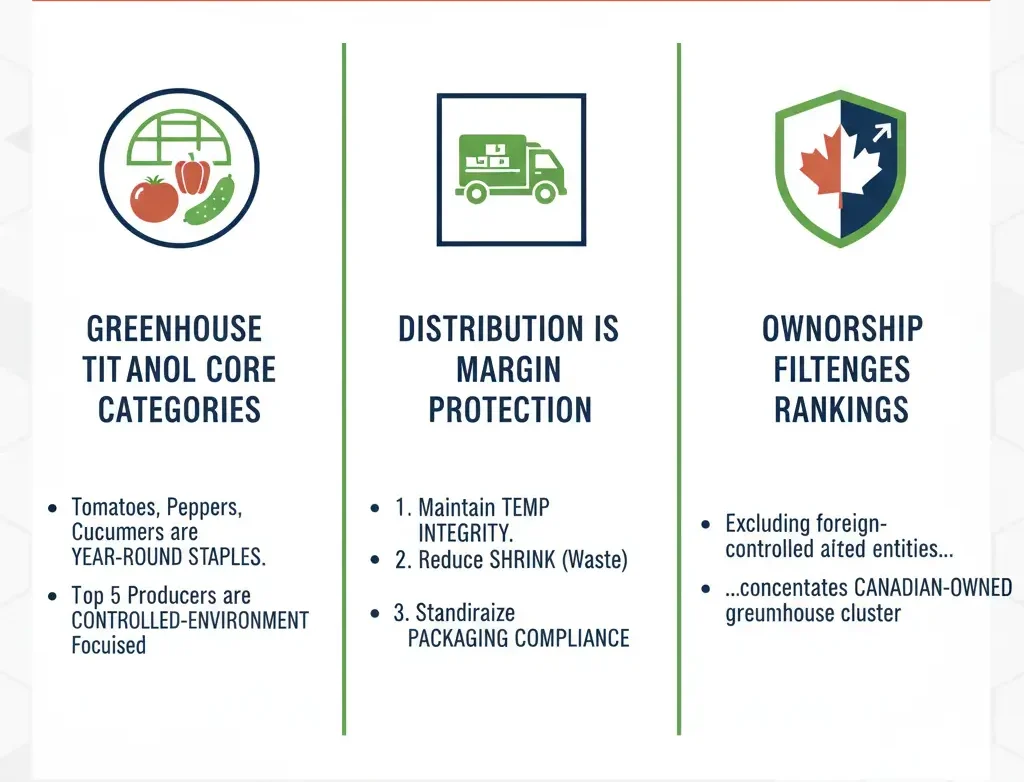
Greenhouse Titans Control Core Categories
Tomatoes, peppers and cucumbers are no longer seasonal domestic items. They are greenhouse-driven staples. The top five companies on this list operate largely in controlled-environment agriculture.
Distribution Is Margin Protection
Distribution-heavy firms protect retailer profitability by:
- Maintaining temperature integrity
- Reducing shrink
- Standardising packaging compliance
Ownership Filtering Changes the Rankings
When foreign-controlled entities are removed, the Canadian-controlled greenhouse cluster becomes even more concentrated.
FAQ
Who is the largest greenhouse company in Canada?
Mastronardi Produce (SUNSET) is the largest majority Canadian-owned greenhouse platform headquartered in Canada in 2026.
Which province leads fresh produce production in Canada?
Ontario leads in greenhouse vegetable production. British Columbia anchors Western greenhouse and distribution supply.
Why are greenhouse firms dominating grocery stores in Canada?
Controlled Environment Agriculture enables stable year-round supply, consistent quality and better retail compliance than field-grown seasonal production.
Conclusion
The largest majority Canadian-owned fresh produce companies in 2026 are overwhelmingly greenhouse-driven and vertically integrated. They are closely aligned with the needs of national grocery stores in Canada.
Ontario and British Columbia remain the structural anchors of domestic vegetable supply. They support year-round programs for major supermarket chains and private label lines.
As grocery stores in Canada continue tightening quality standards and packaging requirements, fresh produce suppliers are operating more like FMCG brands in Canada. They focus on consistency, presentation, traceability and retail-ready formats.
Scale, acreage, cold-chain precision and packaging compliance now define leadership across the Canadian fresh produce landscape.
Editor’s Note: This ranking is based on publicly available corporate information and industry benchmarking for FY2025–FY2026. Most firms are privately held and do not publish audited revenue. Estimated ranges are directional and reflect industry scale comparisons rather than formal disclosures.