
Germany’s retail industry is transforming how it thinks about packaging. In 2025, sustainability, circular design and refill systems are no longer niche experiments. They are mainstream expectations.
The push comes from consumers, policymakers and companies. All are determined to meet the requirements of the Packaging Act (VerpackG). This law defines how packaging should be designed, recycled and reused in the country.
The trend known as packaging innovation Germany 2025 has become a shared mission across supermarkets, private-label suppliers and packaging manufacturers. The aims are:
- Reduce waste
- Replace materials
- Close the loop on packaging
Packaging Innovation Germany 2025: Circular Design And Recyclability
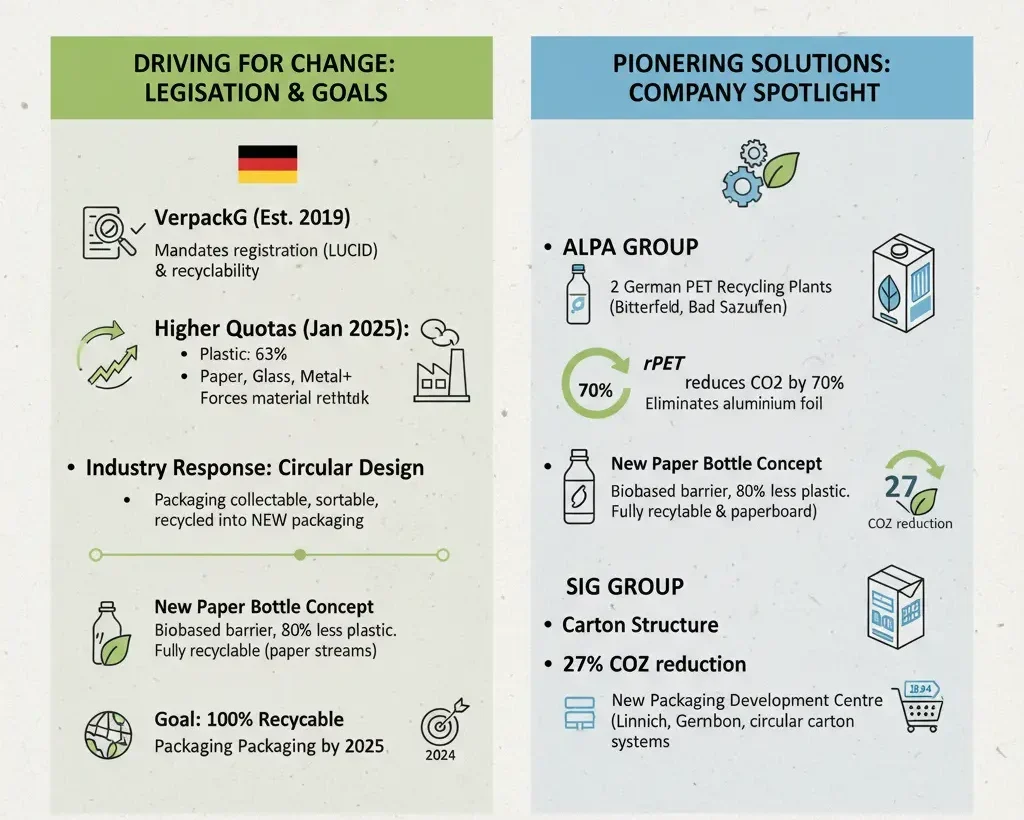
This information comes from Germany’s Central Packaging Register (Zentrale Stelle Verpackungsregister – ZSVR). The VerpackG requires all companies placing packaging on the German market to register with the LUCID database. They must also ensure that packaging can be recycled or reused.
From January 2025, higher recycling quotas apply:
- Plastic: at least 63 %
- Paper, glass and metals: 90 % or more
This has forced packaging companies to rethink material composition and product design.
ALPLA Group
ALPLA Group is one of Germany’s most active packaging manufacturers. It says circular design means creating packaging that can be collected, sorted and recycled back into new packaging. It should not be down-cycled.
ALPLA operates two PET recycling plants in Germany, in Bitterfeld-Wolfen and in Bad Salzuflen. There it converts used PET bottles into high-grade recyclate for new bottles.
The company states that its rPET (recycled PET) reduces carbon emissions by up to 70 % compared to virgin material.
ALPLA has also developed a new paper bottle concept using a thin barrier layer made from biobased material. According to company reports, this design achieves full recyclability within standard paper streams. It also reduces the plastic content by 80 %.
These innovations are part of the company’s goal to reach 100 % recyclable packaging by 2025. Major retail customers in Germany and Austria support this goal.
SIG Group
At the same time, SIG Group, which produces aseptic cartons, has introduced a metal-free carton structure that removes aluminium foil.
According to SIG, the switch reduces carbon emissions by 27 %. It also simplifies recycling, since the entire pack is made of polymers and paperboard.
SIG’s new Packaging Development Centre in Linnich, Germany, opened in 2024. It is dedicated to creating low-carbon, fully circular carton systems for Europe’s beverage market.
This shows how German innovation is moving from concept to scale, aligning technical design with recyclability.
Retailers’ Packaging Reduction Targets
Packaging innovation in Germany 2025 is not limited to suppliers. Supermarkets are equally committed.
REWE and EDEKA
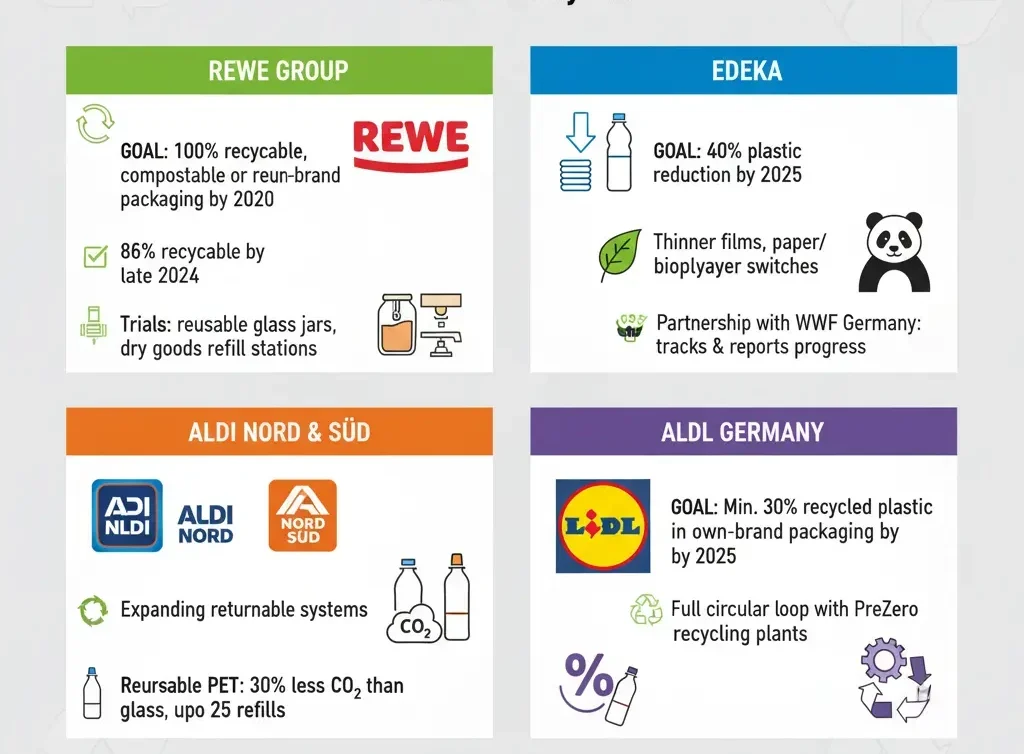
According to REWE Group, the company aims to make all own-brand packaging recyclable, compostable or reusable by the end of 2030.
By late 2024, it had already reached 86 % recyclable packaging across its private-label range. REWE is also trialling reusable glass jars for sauces and spreads. It is testing refill stations for dry goods in selected stores too.
EDEKA has set similar goals. According to its sustainability report, EDEKA’s packaging strategy focuses on reducing plastic use by 40 % by 2025. It is using thinner films and switching to paper or biopolymer solutions.
In partnership with WWF Germany, EDEKA tracks packaging reductions annually and reports progress publicly.
Aldi and Lidl
Meanwhile, Aldi Nord and Aldi Süd are expanding returnable systems. Both companies have increased the share of reusable PET bottles in their beverage ranges.
According to Aldi, reusable PET emits around 30 % less CO₂ than glass bottles. The bottle can be refilled up to 25 times before recycling.
These retailer commitments make packaging innovation part of the competitive landscape, not just environmental compliance.
Even discounters like Lidl have become active innovators. Lidl Germany announced that by 2025 it will use at least 30 % recycled plastic in all own-brand plastic packaging.
The retailer’s logistics partner PreZero is a subsidiary of the Schwarz Group. It operates advanced recycling plants that feed material directly back into Lidl’s supply chain. This creates a full circular loop between consumer and shelf.
This combined retailer pressure is pushing suppliers toward lightweight, mono-material and refillable designs. These designs satisfy both regulation and supermarket performance standards.
Material Innovations And Smart Labelling
Packaging innovation Germany 2025 is defined by the next generation of materials and digital traceability.
Gerresheimer AG
According to Gerresheimer AG, the Düsseldorf-based packaging specialist is expanding its portfolio of rPET and rPP containers for cosmetics and food applications.
Gerresheimer worked with natural-cosmetics brand 4peoplewhocare GmbH. The result was a fully recyclable cream jar made from 100 % post-consumer recycled plastic, designed and produced in Germany.
The company also reports strong demand for refill-ready packaging systems. This is especially true in personal-care and pharma-adjacent products sold in supermarkets and drugstores.
SCHOTT AG
Meanwhile, SCHOTT AG, one of Germany’s oldest glass manufacturers, is leading the move to low-carbon and circular glass.
In 2025, SCHOTT introduced a Product Carbon Footprint (PCF) guideline for all its specialty glass categories. This helps customers compare material emissions.
The company’s sustainability division highlights three priorities:
- Eco-design
- Decarbonised melting
- Circular reuse of glass cullet in production
By integrating these principles, SCHOTT enables retailers and brands to source verified low-impact glass packaging for food and beverage lines.
Smart labelling and data
Digital technology is also becoming part of packaging.
SIG Group has introduced connected carton solutions using QR codes. These allow consumers to scan products for recycling instructions and traceability data.
This “smart labelling” approach supports Germany’s extended producer-responsibility goals. It provides transparency for recycling and reuse rates.
According to ALPLA, data-driven packaging design will be a core focus in the coming years. It will combine physical circularity with digital tracking for collection and sorting.
These systems could allow supermarkets to monitor packaging flows. They could also report real recycling performance under the VerpackG framework.
The Role Of The German Packaging Act (VerpackG)
This is based on official information from the Central Agency Packaging Register (ZSVR). The German Packaging Act defines clear responsibilities for all market participants.
Manufacturers and importers must:
- License packaging with a “dual system”
- Ensure recyclability
- Report volumes through the LUCID Register
The latest 2025 amendment tightened obligations for online retailers and refill systems. It created a more transparent, data-based framework.
For companies in the FMCG and supermarket sector, compliance has moved beyond paperwork. It now drives innovation.
To meet collection and recycling quotas, packaging must be designed for existing infrastructure. That is why German companies such as ALPLA and SIG have aligned R&D directly with these legal targets.
The Act has also created market incentives. Producers who use eco-friendly or mono-material packaging may qualify for lower licensing fees in the dual systems.
As a result, many manufacturers now see recyclability not as a cost, but as a saving. This idea underpins much of packaging innovation Germany 2025.
How Refill Models And Glass Return Systems Are Expanding
Refill and reuse models are gaining momentum across Germany.
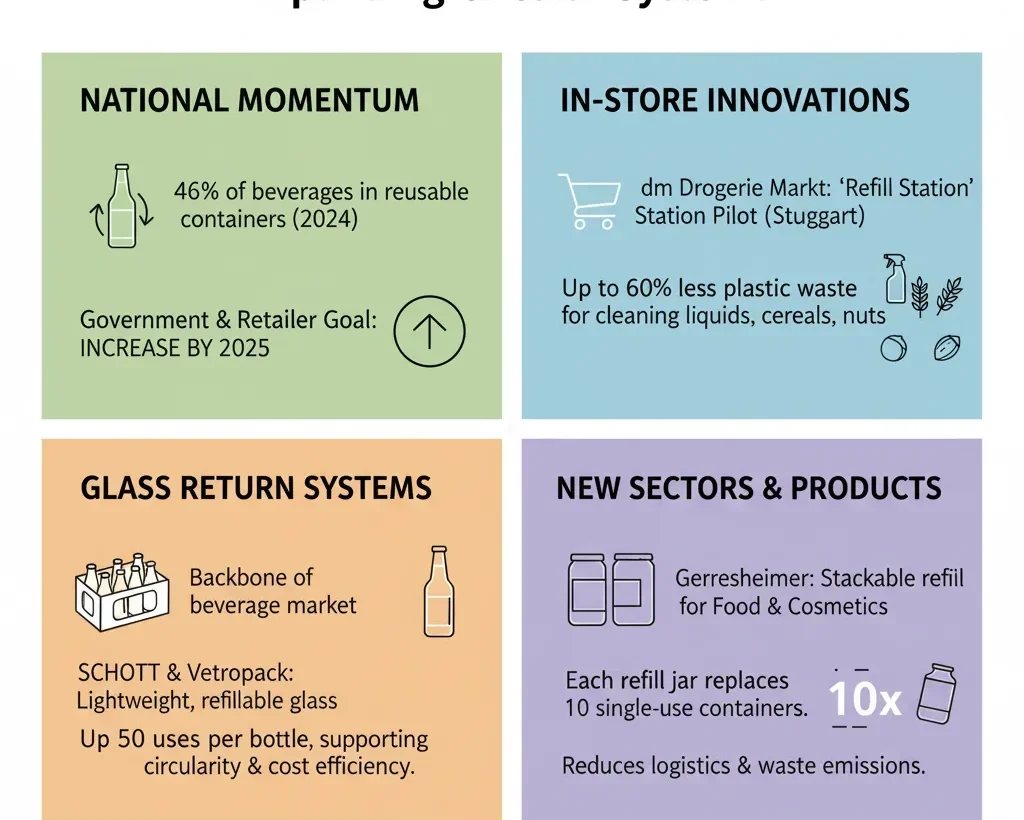
According to Environmental Action Germany (DUH), about 46 % of beverages in Germany were sold in reusable containers in 2024. The government’s goal is to increase that share further by 2025 through retail partnerships.
Retailers are experimenting with in-store refill options for products like cleaning liquids, cereals and nuts.
According to dm Drogerie Markt, its “Refill Station” pilot in Stuttgart reduced single-use plastic waste by up to 60 % for selected product categories.
Glass return systems remain a backbone of the German beverage market.
SCHOTT AG and Vetropack Germany both report increased demand for lightweight, refillable glass bottles. These can be washed and reused up to 50 times.
This trend supports both circular economy goals and cost efficiency in the long term.
Even beyond beverages, refill thinking is entering new sectors. Gerresheimer has partnered with FMCG customers to develop stackable refill jars for food and cosmetic ranges.
The company reports that each refillable jar can replace ten single-use containers. This reduces emissions across logistics and waste treatment.
Why It Matters
The transformation in packaging is reshaping German retail strategy. Packaging is no longer just a container. It is a message about sustainability, innovation and compliance.
For supermarkets, the benefits go beyond meeting regulations. Lighter and circular packaging:
- Reduces transport costs
- Improves shelf efficiency
- Builds trust with environmentally aware consumers
Suppliers, in turn, are developing entire product families based on recyclability. Companies like ALPLA, Gerresheimer, SIG and SCHOTT AG are proving that sustainable packaging can be both technically advanced and commercially viable.
For private-label brands, this shift has strategic value.
Retailers can use innovative packaging to set their own-brand products apart from A-brands. This strengthens consumer loyalty while meeting environmental goals.
This links directly with broader developments in, Supermarket Sustainability in Germany, and Retail Technology in German Supermarkets. All of these support the same long-term goal: sustainable growth through smarter design.
Frequently Asked Questions
What recycling quotas apply under Germany’s Packaging Act from 2025?
From January 2025, plastic packaging must reach at least 63 % recycling. Paper, glass and metals must reach 90 % or more.
How far has REWE got with recyclable own-brand packaging?
By late 2024, REWE had reached 86 % recyclable packaging across its private-label range. It aims for all own-brand packaging to be recyclable, compostable or reusable by the end of 2030.
How common is reusable beverage packaging in Germany?
According to DUH, about 46 % of beverages in Germany were sold in reusable containers in 2024. Refillable glass bottles can be washed and reused up to 50 times.
Conclusion
By 2025, packaging innovation Germany 2025 has evolved from a sustainability slogan into an operational standard.
Several practices are becoming normal:
- Circular design
- Refill models
- Smart materials
- Digital traceability
Germany’s packaging ecosystem, from manufacturers to supermarkets, is showing what a coordinated approach can achieve. A regulated, innovation-driven model can make packaging both responsible and profitable.
The next stage will be about scale. That means integrating these innovations across all product lines and ensuring consumers adopt reuse systems as part of daily shopping habits.
For now, Germany stands as Europe’s benchmark for packaging transformation. It is built not only on policy, but on continuous innovation.
Editor’s Note:
This article is based on verified data and official publications from:
- ALPLA Group – Sustainability Reports 2024–2025 and company innovation pages.
- SIG Group – Packaging Development Centre Linnich news release 2024.
- Gerresheimer AG – Sustainability Updates and partnerships with 4peoplewhocare GmbH.
- SCHOTT AG – Sustainability strategy and Product Carbon Footprint guideline 2025.
- REWE Group and EDEKA – Sustainability Reports 2024–2025.
- Aldi Nord, Aldi Süd, and Lidl Germany – Circular packaging commitments and PreZero recycling initiatives.
- Central Packaging Register (ZSVR) – German Packaging Act (VerpackG) 2025 updates.
- Environmental Action Germany (DUH) – Reusable packaging market data 2024–2025.
- dm Drogerie Markt – Refill station pilot reports.
All data and statements reflect updates available up to November 2025.