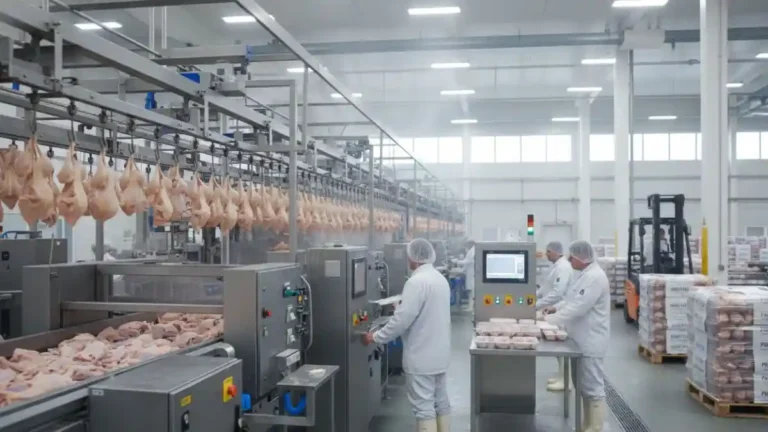

Romanian-owned private label manufacturers supply major supermarket chains, including:
- Kaufland
- Carrefour
- Lidl
- Auchan
- Profi
- Mega Image
In 2026, the largest domestic food producers combine billion-RON turnover, integrated production systems and certified food safety compliance. Together, these support supermarket own-brand growth across poultry, processed meat, pasta and staples.
A private label manufacturer produces food products sold under a supermarket’s own brand rather than the producer’s brand.
In Romania, these companies make poultry, processed meat, pasta, flour, frozen goods and beverages. These appear on supermarket shelves under retailer labels.
Top Romanian Private Label Manufacturers (FY2024)
| Rank | Company | FY2024 Revenue (RON) | Core Category | Ownership |
|---|---|---|---|---|
| 1 | Cris-Tim | 1.12 Billion | Processed Meat | Romanian |
| 2 | Agricola International | 1.21 Billion (Group) | Poultry | Romanian |
| 3 | Transavia | ~1 Billion (Group) | Poultry | Romanian |
| 4 | Unicarm | ~438 Million | Meat Processing | Romanian |
| 5 | Pambac | ~290 Million | Pasta & Milling | Romanian |
| 6 | Boromir Group | Industrial Scale | Milling & Bakery | Romanian |
| 7 | Safir | Industrial Scale | Poultry | Romanian |
| 8 | Macromex | Industrial Scale | Frozen Foods | Romanian |
| 9 | Zarea | Industrial Scale | Wine | Romanian |
| 10 | Sam Mills | Export-Oriented Scale | Pasta & Corn Products | Romanian |
Revenue figures reflect 2024/2025 public disclosures and business reporting. Where consolidated figures apply, group revenue is used.
How are the top Romanian private label manufacturers ranked?
Private label manufacturing in Romania is defined by four key requirements:
- Romanian majority ownership
- FY2024 revenue scale consistent with national supermarket supply
- Industrial production capacity in Romania
- Compliance with international food safety standards (IFS, BRCGS, ISO 22000, HACCP)
Revenue is the primary ranking factor. Production integration and private label exposure determine placement.
Who are the top 10 Romanian-owned food manufacturers in 2026?
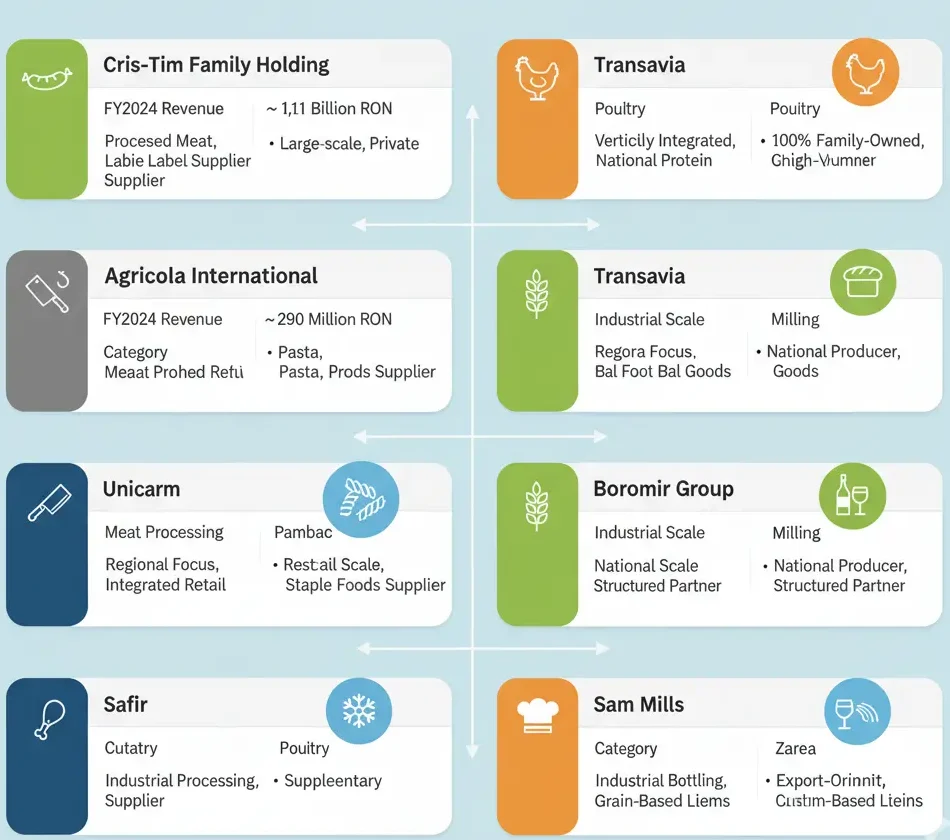
Below is the verified ranking based on updated financial indicators.
1. Cris-Tim Family Holding
- FY2024 Revenue: 1.12 Billion RON
- Category: Processed meat, chilled foods
- Ownership: Romanian entrepreneurial group
Cris-Tim operates large-scale industrial meat processing facilities. It has moved to a holding structure, reflecting its corporate expansion and operational scale.
In 2025, its private label production grew by about 8% year on year. This strengthened its position as a key supplier for supermarket own-brand programs.
The company is a high-volume processed meat partner for retailer cold-cut ranges. It keeps a multi-chain presence within the chilled category across modern retail networks.
2. Agricola International
- FY2024 Group Revenue: 1.21 Billion RON
- Category: Poultry and prepared foods
- Ownership: Romanian
Agricola operates a vertically integrated poultry chain. It covers feed production, farming, slaughtering and processing, giving it full control over the supply cycle.
With consolidated revenue above 1.2 billion RON, it ranks among Romania’s largest domestic food producers.
Its integrated structure enables consistent high-volume delivery under retailer brands. This positions the company as a national protein supply anchor within modern supermarket networks.
3. Transavia
- FY2024 Group Revenue: about 1 Billion RON
- Category: Poultry
- Ownership: 100% Romanian family-owned
Transavia operates fully integrated poultry facilities. It manages the entire production chain from farming to processing.
Its output exceeds 120,000 tonnes annually, and its revenue is around the one-billion-RON level. This places it among Romania’s dominant protein producers.
Its vertically controlled structure makes it well suited for high-volume supermarket private label contracts. This reinforces its position as a national leader in poultry supply within modern retail.
4. Unicarm
- FY2024 Revenue: about 438 Million RON
- Employees: ~1,100
- Category: Meat processing
- Ownership: Romanian
Unicarm combines integrated meat processing operations with established retail distribution depth, especially across regional markets.
Its strong regional presence and large workforce provide the capacity needed for private label production in chilled and processed meat categories.
This structure lets the company act as a flexible, regional-scale supplier. It is a dependable supermarket partner within its core operating areas.
5. Pambac
- FY2024 Revenue: about 290 Million RON
- Category: Pasta and milling
- Ownership: Romanian
Pambac, headquartered in Bacău, is a significant Romanian producer of pasta and flour. It operates at industrial scale within the staple foods segment.
Pasta continues to be a core private label category in Romania. Steady household consumption and price-sensitive demand support it.
Pambac’s high-volume manufacturing capacity lets it supply supermarket own-brand pasta and flour ranges. This reinforces its role as a staple goods supplier within modern retail networks.
6. Boromir Group
- FY2024 Revenue: Industrial-scale national producer (exact figure requires consolidated extraction)
- Category: Milling and bakery
Boromir operates flour mills and bakery production units across Romania. This gives it a strong industrial base in staple food manufacturing.
Milling remains the foundation for private label flour and bakery products, especially in high-volume and seasonal categories.
Through its production network, Boromir is a key partner for supermarket flour and bakery ranges. It keeps a national presence within the staple goods supply chain.
7. Safir
- Category: Poultry
- Ownership: Romanian
Safir operates poultry slaughtering and processing facilities at industrial scale. This places the company within Romania’s structured protein supply segment.
In private label manufacturing, production volume and processing capacity decide eligibility. Safir meets the operational threshold required by modern retail chains.
This lets the company work as a supplementary poultry supplier within supermarket private label programs.
8. Macromex
- Category: Frozen foods
- Ownership: Romanian
Macromex operates in frozen food production and distribution. This segment depends heavily on cold-chain infrastructure and coordinated industrial logistics.
Frozen private label programs need reliable storage, transport and supply continuity. Macromex maintains operational capability in these areas.
This positions the company as a structured frozen private label partner across supermarket freezer categories.
9. Zarea
- Category: Wine and sparkling wine
- Ownership: Romanian
Zarea is a long-standing Romanian wine producer with established industrial bottling capability and national distribution reach.
Its production infrastructure supports custom-branded wine lines made to retailer specifications. This lets the company take part in supermarket private label programs within the wine and sparkling wine segment.
10. Sam Mills
- Category: Pasta and corn-based products
- Ownership: Romanian
Sam Mills operates export-oriented pasta and grain processing facilities, with industrial capacity in corn- and wheat-based products.
Its production scale and processing specialism let it make grain-based items that fit supermarket private label requirements. This applies especially in staple and value-focused retail segments.
Why Does Protein Dominate Romanian Private label Manufacturing?
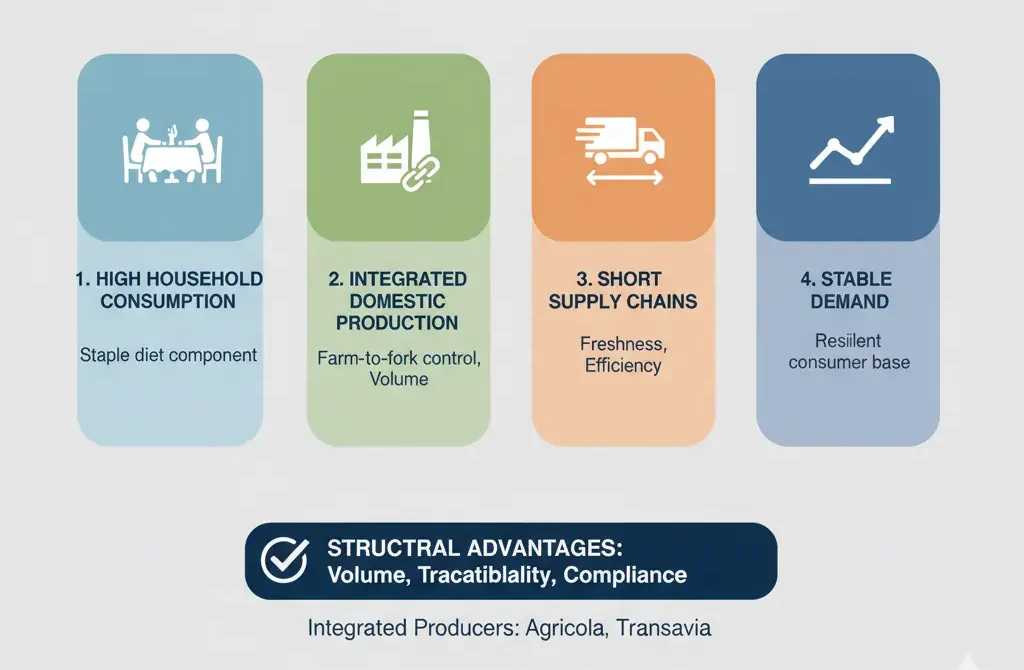
Poultry and processed meat represent the largest private label segments due to:
- High household consumption
- Integrated domestic production
- Short supply chains
- Stable demand
Integrated protein producers such as Agricola and Transavia have structural advantages in volume, traceability and compliance.
What categories drive supermarket private label growth?
Private label growth in Romania is concentrated in:
- Poultry and processed meat
- Flour and pasta
- Frozen foods
- Bakery
- Wine
Staple goods and protein remain dominant due to price sensitivity and volume stability.
Compliance and Certification Standards
Private label manufacturing in Romania requires:
- IFS Food certification
- BRCGS Food Safety
- ISO 22000
- HACCP systems
Large Romanian manufacturers maintain these certifications to qualify for supermarket contracts.
Frequently Asked Questions
Which supermarket chains do Romanian private label manufacturers supply?
They supply major chains including Kaufland, Carrefour, Lidl, Auchan, Profi and Mega Image.
Which companies lead Romanian private label manufacturing by revenue?
Cris-Tim (1.12 billion RON) and Agricola International (1.21 billion RON group revenue) lead the market. Transavia follows closely with about 1 billion RON in group revenue.
What certifications do Romanian private label manufacturers need?
Supermarket contracts require IFS Food certification, BRCGS Food Safety, ISO 22000 and HACCP systems.
Conclusion
Romania’s private label manufacturing sector is concentrated among billion-RON protein processors and staple producers. Cris-Tim and Agricola now clearly lead the market by revenue scale, followed closely by Transavia.
Their scale and integration make them structural partners within the wider Romanian supermarket ecosystem, where retailer own-brand penetration continues to expand.
Industrial integration, compliance readiness and national distribution capacity define supplier eligibility for modern retail private label contracts in 2026.
Competition is intensifying across the broader Romanian FMCG market. Domestic manufacturers with certified production systems and stable supply chains remain best positioned to support supermarket private label growth.
Romanian-owned producers continue to play a central role in national supermarket supply chains, especially across protein and staple categories.
Editor’s Note: This ranking is based on publicly available FY2024 financial disclosures and confirmed Romanian ownership as of early 2026. Only Romanian-owned food manufacturers with industrial-scale production relevant to supermarket private label supply were included.