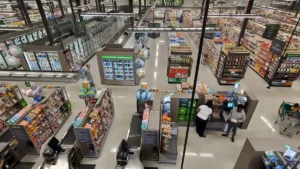
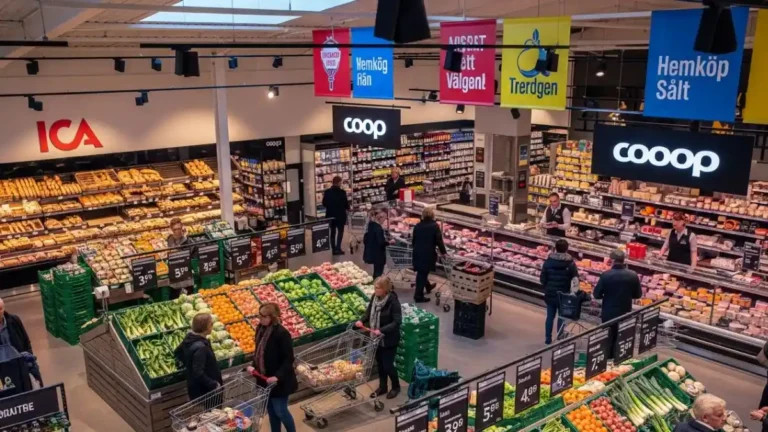

Sweden’s grocery retail market remains one of the most concentrated in Europe.
A small number of national supermarket groups control the majority of food sales, logistics flows, and supplier negotiations.
By 2026, this concentration has tightened further. Scale, private label penetration, and distribution efficiency now determine competitive position more than store count alone.
Precise market share varies slightly by methodology. Even so, all major industry sources place the same five groups firmly at the top of Swedish grocery retail.
Below this level, remaining players are fragmented and structurally marginal.
This ranking reflects estimated national grocery market share, supported by net sales, store footprint, and workforce scale. It is based on publicly available FY2024–FY2025 company disclosures.
Sweden grocery market overview
- Highly concentrated national structure
- Strong wholesaler-backed and cooperative retail models
- Among Europe’s highest private label penetration rates
- Logistics and automation central to margin protection
- Limited space for new national entrants
5 Supermarket Chains In Sweden By Market Share
| Rank | Supermarket group | Market share (est.) | Revenue (SEK bn) | Employees | Stores |
|---|---|---|---|---|---|
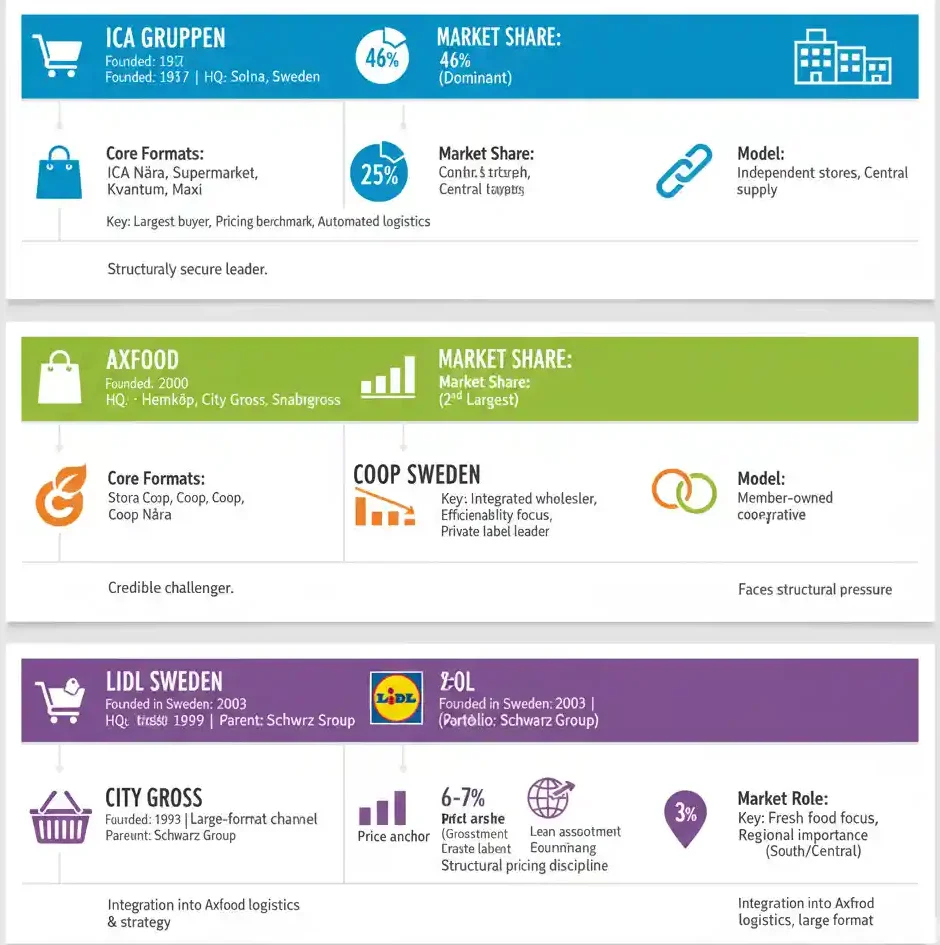
| 1 | ICA Gruppen | ~46% | 178.1 | 41,000+ | 1,260+ |
| 2 | Axfood | ~25% | 89.2 | 15,000+ | 680+ |
| 3 | Coop Sweden | ~16–17% | 58.8 | 20,000+ | 800+ |
| 4 | Lidl Sweden | ~6–7% | 22.0 | 5,300+ | 200+ |
| 5 | City Gross (Axfood) | ~3% | 3.0 | 2,800+ | 40+ |
1. ICA Gruppen
- Founded: 1917
- Headquarters: Solna, Sweden
Core formats
- ICA Nära
- ICA Supermarket
- ICA Kvantum
- ICA Maxi
Market position and scale
ICA remains Sweden’s dominant grocery retailer.
Its estimated market share of around 46 percent places it clearly ahead of all competitors. It does not breach the symbolic 50 percent threshold often referenced in regulatory discussions.
The group’s structure is distinctive. Stores are independently owned but centrally supplied, branded, and coordinated.
This model combines local autonomy with national purchasing power.
ICA’s store network covers urban centres, suburbs, and rural communities. This reach gives the group unmatched leverage across fresh food, packaged groceries, and private label sourcing.
Operational relevance
- Largest grocery buying organisation in Sweden
- Central reference point for national pricing architecture
- Critical volume partner for packaging, meat, dairy, produce, and ambient suppliers
ICA’s logistics platform is mature and highly automated. Central category management ensures consistency, while store-level flexibility supports local range adaptation.
Private label position
Private label is embedded across all ICA tiers. Ranges span entry price, mainstream, premium, and sustainability-led products.
This breadth supports margin stability and strong shelf control. For suppliers, ICA often sets national standards on pack size, formulation, and compliance.
Latest ICA developments: ICA Gruppen has begun recruiting a successor after ICA Sverige CEO Eric Lundberg announced he will step down by February 2027.
The retailer is also using its national store network for an ICA and Swedish Red Cross preparedness campaign running across Sweden in September 2026.
Strategic direction
- Continued investment in automation and forecasting
- Tightened supplier requirements
- Incremental expansion of premium and sustainability ranges
ICA’s leadership position remains structurally secure.
2. Axfood
- Founded: 2000
- Headquarters: Stockholm, Sweden
Core formats
- Willys
- Hemköp
- City Gross
- Snabbgross
Market position and scale
Axfood is Sweden’s second-largest grocery group and the country’s strongest integrated wholesaler-retailer model.
With the full integration of City Gross completed in late 2024, Axfood’s estimated market share has risen to around 25 percent by 2026.
Unlike ICA, Axfood operates centrally controlled retail banners. This enables faster national execution across pricing, promotions, and private label development.
Operational relevance
- One of Sweden’s largest food wholesalers
- Highly automated logistics and distribution network
- Multi-format reach from discount to large-format retail
Axfood’s supply chain investments have focused on cost discipline and throughput efficiency. This has supported Willys’ aggressive discount positioning while preserving profitability.
Private label leadership
Axfood is widely regarded as Sweden’s most advanced private label operator.
Key ranges include:
- Garant
- Eldorado
- Hemköp-exclusive lines
Private label penetration is high across all formats. This strengthens Axfood’s negotiating position with both branded suppliers and packaging partners.
Strategic direction
- Private label expansion
- Clearer format differentiation
- Logistics efficiency over rapid store growth
Axfood remains the most credible structural challenger to ICA.
3. Coop Sweden
- Founded: 1899
- Headquarters: Solna, Sweden
Core formats
- Stora Coop
- Coop
- Coop Nära
Market position and scale
Coop is Sweden’s third-largest grocery retailer, operating through a member-owned cooperative structure.
Its estimated market share of 16–17 percent reflects a gradual decline over the past decade, as discount formats have gained ground.
Coop maintains a dense national store network, particularly in urban and suburban areas.
Operational relevance
- Large national footprint
- Strong presence in everyday food categories
- Significant sourcing volumes despite declining share
The cooperative structure provides local engagement but limits speed of execution compared with more centralised competitors.
Private label position
Coop operates several established private label ranges:
- Änglamark
- Coop Xtra
- Coop premium selections
These ranges support Coop’s sustainability and ethics-led positioning. Margins remain more exposed due to cost structure and price competition.
Strategic direction
- Cost control and restructuring
- Store profitability over expansion
- Simplification of operations
Coop remains a core national player but faces ongoing structural pressure.
4. Lidl Sweden
- Founded in Sweden: 2003
- Parent group: Schwarz Group
Core format
- Discount supermarket
Market position and scale
Lidl’s estimated market share of 6–7 percent is modest compared with other European markets. But its influence exceeds its size.
With more than 200 stores nationwide, Lidl exerts sustained downward pressure on prices across key categories.
The group reported its first sustained profitability in Sweden during FY2024–FY2025.
Operational relevance
- Highly centralised European sourcing
- Lean assortment strategy
- Strong private label dominance
Lidl’s model limits opportunities for branded suppliers but sets efficiency benchmarks for the wider market.
Strategic direction
Lidl’s role in Sweden is structural rather than dominant.
It functions as a pricing anchor and competitive discipline mechanism.
5. City Gross
- Founded: 1993
- Ownership: Axfood
Market position and role
City Gross represents around 3 percent of the Swedish grocery market. Its importance lies in format strategy rather than scale.
Following its acquisition by Axfood, City Gross has shifted from challenger status to portfolio component.
Operational relevance
- Large basket sizes
- Strong fresh food focus
- Regional importance in southern and central Sweden
Strategic direction
- Integration into Axfood logistics
- Range rationalisation
- Price repositioning
City Gross now serves as a complementary large-format channel within Axfood’s broader strategy.
Market structure impact
Sweden’s grocery market is defined by concentration.
The top two groups alone control more than 70 percent of national sales.
This structure shapes:
- Supplier pricing power
- Packaging standardisation
- Speed of innovation adoption
Barriers to entry remain high due to logistics costs and real estate constraints.
Category dominance trends
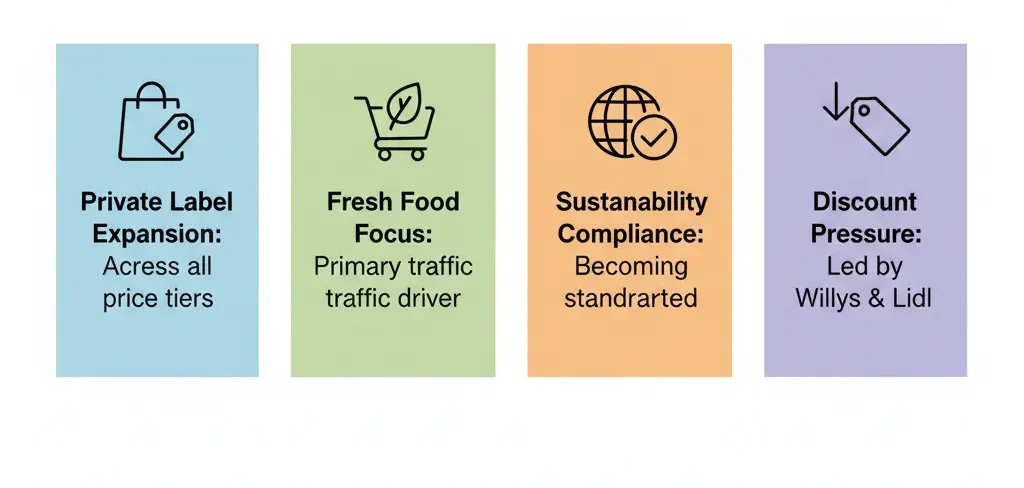
Key trends shaping Swedish supermarkets:
- Private label expansion across all price tiers
- Fresh food as the primary traffic driver
- Sustainability compliance becoming standardised
- Discount pressure led by Willys and Lidl
Industry outlook
Through 2026, the Swedish grocery market is expected to remain structurally stable.
Key developments:
- Increased automation in distribution
- Further segmentation of private label ranges
- Tighter supplier and packaging compliance standards
- Limited national consolidation beyond current players
Market share shifts are likely to be incremental rather than disruptive.
Frequently Asked Questions
Which is the largest supermarket chain in Sweden?
ICA Gruppen is the largest, with an estimated market share of around 46 percent. It has revenue of SEK 178.1 bn and more than 1,260 stores.
How concentrated is the Swedish grocery market?
It is one of the most concentrated in Europe. The top two groups alone control more than 70 percent of national sales.
Where does Lidl rank in Sweden?
Lidl ranks fourth, with an estimated market share of 6–7 percent and more than 200 stores. Its influence exceeds its size, because it exerts sustained downward pressure on prices.
Conclusion
The Swedish grocery market in 2026 is defined by scale, discipline, and private label power.
- ICA remains the clear leader.
- Axfood continues to strengthen its position.
- Coop retains relevance under pressure.
- Lidl shapes price discipline.
- City Gross plays a strategic supporting role.
For suppliers across the Sweden FMCG sector, commercial access is concentrated within these five supermarket chains.
The same applies to Sweden packaging manufacturers and logistics providers. Their volumes and compliance standards are closely tied to the requirements set by this narrow group of national retailers.
Editor’s Note: This article is based on publicly available company financial reports, annual disclosures, and Swedish grocery market data covering FY2024–FY2025.
Supplier-origin positioning is also developing in Sweden, where Skånemejerier is adding the Mjölk från Sverige mark to its Swedish-made cheese.