

Which FMCG brand has highest revenue in Denmark? As of early 2026, Arla Foods remains the clear market leader among Denmark-headquartered FMCG companies. It is followed by Carlsberg Group and Danish Crown. These three companies form the backbone of Denmark’s FMCG economy.
Together, they control a large share of export value, supplier capacity, retail shelf influence, and category pricing power across Northern Europe.
This ranking is designed to give a clear picture of Denmark’s FMCG market power structure. It focuses on five factors:
- Revenue scale
- Retail presence
- Export strength
- Supplier influence
- Category leadership
The list includes well-known consumer brands. It also includes major “behind-the-shelf” producers. Their products and ingredients quietly shape what shoppers see, buy, and pay for in supermarkets.
FMCG Brand Overview (Denmark Headquarters)
| Rank | Brand | Revenue (Latest Direction) | Employees | Global Presence |
|---|---|---|---|---|
| 1 | Arla Foods | €13.8 billion | 23,000+ | Operations in 35+ countries |
| 2 | Carlsberg Group | DKK 82+ billion | 37,000+ | Sales in 120+ markets |
| 3 | Danish Crown | DKK 65.4 billion | 23,000+ | Export to 130+ markets |
| 4 | Royal Unibrew | DKK 15.0 billion | 4,200+ | Strong Nordic and European footprint |
| 5 | Novonesis | €5.0+ billion target | 10,000+ | 40+ countries |
| 6 | Scandinavian Tobacco Group | DKK 9.7 billion | 9,300+ | Global regulated FMCG footprint |
| 7 | ESS-FOOD | DKK 6.1 billion | 140+ | International B2B trading network |
| 8 | Palsgaard | DKK 2.4 billion | 800+ | Production and offices in 20+ countries |
| 9 | Goodvalley | DKK 2.3 billion | 1,700+ | Integrated European meat operations |
| 10 | Toms Group | DKK 1.6 billion | 1,200+ | Nordic core with export markets |
Revenue Momentum and Category Influence
| Brand | Market Direction (2026) | Dominant Categories |
|---|---|---|
| Arla Foods | Stable growth, record farmer payouts | Dairy, butter, cheese, ingredients |
| Carlsberg Group | Expansion driven by beverage portfolio | Beer, soft drinks, RTD |
| Danish Crown | Restructuring for margin recovery | Fresh meat, processed foods |
| Royal Unibrew | Consistent organic growth | Beer, soft drinks |
| Novonesis | Post-merger expansion phase | Enzymes, cultures, biosolutions |
| Scandinavian Tobacco Group | Stable regulated revenues | Tobacco and cigars |
| ESS-FOOD | Export-driven turnover | Meat trading, foodservice supply |
| Palsgaard | Ingredient demand growth | Emulsifiers, stabilisers |
| Goodvalley | Vertical integration expansion | Protein production |
| Toms Group | Seasonal FMCG cycles | Chocolate, confectionery |
Brand Profiles
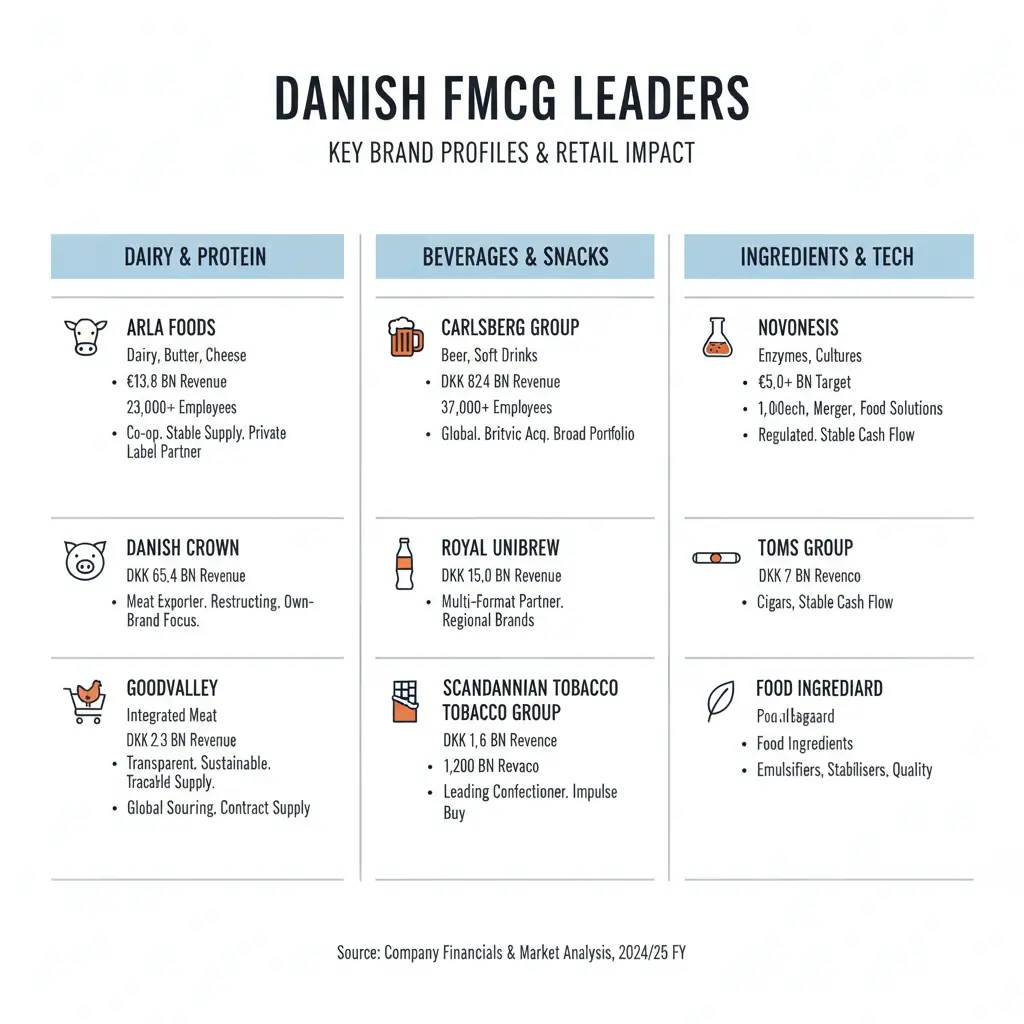
1) Arla Foods
Arla Foods remains Denmark’s largest FMCG company. It is the most influential supplier across Northern European retail dairy categories.
Its cooperative structure gives it direct control over farm-level supply. It also keeps strong processing, export, and brand infrastructure.
The 2024/25 financial year marked a milestone for Arla. The company delivered its highest-ever dividend payout to farmer-owners. This strengthens supplier loyalty and reinforces long-term milk supply stability.
For retailers, this stability is critical. It supports long-term contracts, predictable pricing frameworks, and volume guarantees.
Arla’s scale also allows heavy investment in four areas:
- Automation
- Packaging optimisation
- Energy efficiency
- Sustainability reporting systems
- Revenue: €13.8 billion
- Employees: 23,000+
- Core categories: Dairy, butter, cheese, milk powders
Private label relevance
Arla is deeply involved in contract manufacturing for retailer own brands. Many European private label dairy ranges depend on Arla-operated production facilities. This makes the company a core partner behind supermarket shelves.
2) Carlsberg Group
Carlsberg is Denmark’s most globally visible FMCG exporter. Beer remains its foundation. The group’s profile changed significantly following the Britvic acquisition completed in 2025.
This move strengthened Carlsberg’s non-alcoholic and soft drink portfolio. It gave the group broader leverage across supermarket beverage aisles.
By early 2026, group revenue has trended above DKK 82 billion. Price adjustments, premiumisation strategies, and strong performance in Asian markets supported this.
Carlsberg’s retail importance goes beyond volume. Beverage suppliers shape promotional calendars, multipack strategies, cooler placement, and seasonal merchandising.
- Revenue direction: DKK 82+ billion
- Employees: 37,000+
- Core categories: Beer, soft drinks, RTD beverages
Retail leverage
Carlsberg’s multi-category beverage reach lets retailers consolidate suppliers. They can still expand assortment depth across alcoholic and non-alcoholic segments.
3) Danish Crown
Danish Crown remains Denmark’s largest protein supplier and one of Europe’s most powerful meat exporters. Revenue remains high at DKK 65.4 billion. The company is currently going through a strategic restructuring phase.
This includes reducing slaughter capacity in Denmark. It also means shifting focus toward higher-margin processed and value-added products. The aim is to improve profitability while maintaining export competitiveness.
From a B2B perspective, Danish Crown is essential to retail protein supply chains.
It influences four areas across fresh and processed meat categories:
- Packaging standards
- Traceability systems
- Animal welfare compliance
- Price benchmarks
- Revenue: DKK 65.4 billion
- Employees: 23,000+
- Core categories: Pork, beef, processed foods
Private label overlap
Retailers rely heavily on Danish Crown for own-brand meat ranges, particularly in chilled and ready-to-cook segments.
4) Royal Unibrew
Royal Unibrew operates as a flexible beverage supplier. It has strong regional brands and diversified product portfolios.
Carlsberg has global beer dominance. Royal Unibrew instead positions itself as a multi-format beverage partner for retailers.
This structure lets supermarkets simplify supplier management while expanding beverage assortment coverage.
- Revenue: DKK 15.0 billion
- Employees: 4,200+
- Core categories: Beer, soft drinks, regional beverages
Retail advantage
Retailers value Royal Unibrew’s ability to supply multiple beverage segments through one procurement relationship.
5) Novonesis
Novonesis represents one of Denmark’s most strategically important FMCG enablers. It was formed through the merger of Novozymes and Chr. Hansen. The company operates at the core of food biotechnology.
2024 revenue stood near €3.8 billion. The company is now targeting €5.0+ billion annual revenue as post-merger synergies fully materialise.
Three drivers support these synergies:
- Combined R&D platforms
- Expanded customer integration
- Growing demand for fermentation-based solutions
Novonesis products influence shelf life, texture, flavour stability, and ingredient efficiency across thousands of FMCG SKUs.
- Revenue target: €5.0+ billion
- Employees: 10,000+
- Core categories: Enzymes, cultures, biosolutions
Supplier relevance
Private label manufacturers increasingly depend on biosolutions suppliers. This helps them meet cost targets while maintaining product quality.
6) Scandinavian Tobacco Group
Scandinavian Tobacco Group remains Denmark’s largest regulated FMCG operator.
Tobacco products operate under strict regulatory frameworks. The category still generates stable cash flows and structured retail partnerships.
Revenue has now moved closer to DKK 9.7 billion. This reflects steady category performance despite regulatory pressure.
- Revenue: DKK 9.7 billion
- Employees: 9,300+
- Core categories: Cigars, tobacco products
Retail structure impact
Tobacco categories influence store compliance systems, licensing processes, and restricted merchandising zones.
7) ESS-FOOD
ESS-FOOD plays a specialised role within Denmark’s export-oriented FMCG supply ecosystem.
The company focuses on sourcing, trading, and supplying protein products to retail and foodservice buyers across international markets.
It has a relatively small workforce. ESS-FOOD still manages high-volume international trade flows.
- Revenue: DKK 6.1 billion
- Employees: 140+
- Core categories: Meat trading, contract supply
Private label relevance
ESS-FOOD supports custom retail programs and specification-based supply contracts.
8) Palsgaard
Palsgaard is a critical supplier to Denmark’s confectionery, bakery, dairy, and plant-based food industries.
Its emulsifiers and stabilisers directly influence texture, shelf stability, and cost efficiency across FMCG products.
- Revenue: DKK 2.4 billion
- Employees: 800+
- Core categories: Food ingredients
Retail connection
Ingredient suppliers like Palsgaard allow private label products to match branded quality while protecting margins.
9) Goodvalley
Goodvalley operates a vertically integrated protein production model. It controls farming, processing, and distribution operations under one supply chain structure.
This approach aligns closely with retailer demands for transparency, sustainability documentation, and traceable sourcing.
- Revenue: DKK 2.3 billion
- Employees: 1,700+
- Core categories: Integrated meat supply
Retail relevance
Vertically integrated suppliers reduce compliance risk and supply volatility for large supermarket groups.
10) Toms Group
Toms Group remains Denmark’s leading confectionery producer. Its portfolio is strongest in chocolate, liquorice, and seasonal gift products.
Toms is smaller in revenue scale than the top three. It remains strategically important for impulse-driven FMCG categories.
- Revenue: DKK 1.6 billion
- Employees: 1,200+
- Core categories: Chocolate and confectionery
Private label pressure
Confectionery faces strong competition from retailer own brands. This makes innovation and brand positioning critical.
FMCG Market Structure in Denmark
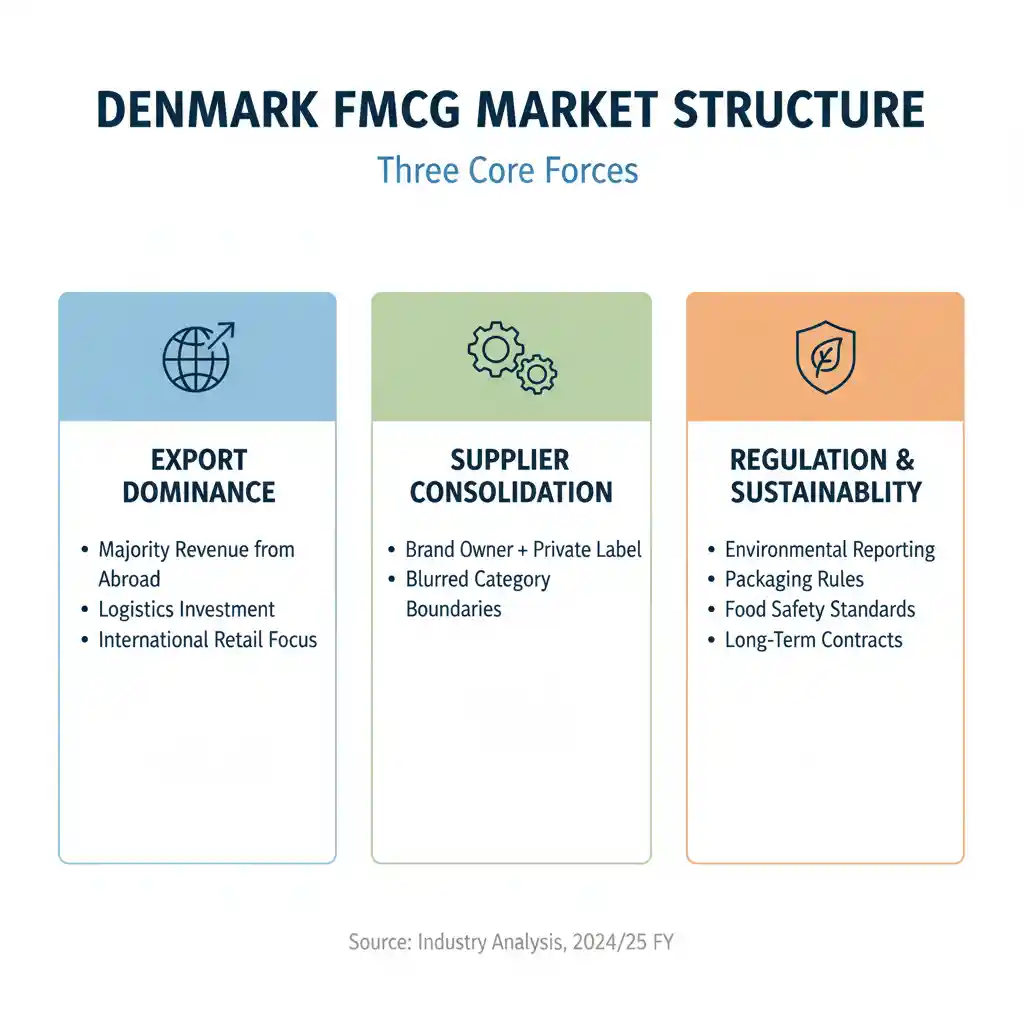
Denmark’s FMCG sector is shaped by three core forces.
Export dominance
Most top FMCG companies generate the majority of revenue outside Denmark. This drives logistics investment and international retail partnerships.
Supplier consolidation
Large manufacturers increasingly operate as both brand owners and private label suppliers. This blurs traditional category boundaries.
Regulation and sustainability pressure
Environmental reporting, packaging rules, and food safety standards influence supplier selection and long-term retail contracts.
Why This Ranking Matters For B2B Buyers
Retail buyers and sourcing managers use rankings like this to:
- Identify long-term supply partners
- Compare category leverage
- Anticipate pricing pressure
- Evaluate consolidation risks
- Plan private label sourcing strategies
For manufacturers, the ranking highlights which competitors control shelf-critical categories.
Frequently Asked Questions
Which FMCG brand has the highest revenue in Denmark?
Arla Foods is the clear market leader among Denmark-headquartered FMCG companies, with revenue of €13.8 billion. Carlsberg Group and Danish Crown follow.
Why is Danish Crown restructuring?
Danish Crown is reducing slaughter capacity in Denmark. It is shifting focus toward higher-margin processed and value-added products. The aim is to improve profitability while maintaining export competitiveness.
How does private label affect Danish FMCG brands?
Large manufacturers increasingly act as both brand owners and private label suppliers. Arla and Danish Crown supply retailer own-brand ranges. Confectionery brands such as Toms Group face strong competition from retailer own brands.
Final Outlook
Denmark’s FMCG market remains highly concentrated. Arla, Carlsberg, and Danish Crown continue to dominate revenue and infrastructure.
Ingredient and biosolution suppliers such as Novonesis and Palsgaard also quietly shape how FMCG products are formulated and priced.
The balance between brand power and private label expansion will define the next phase of the Danish FMCG market.
For retailers, the challenge remains the same. Protect margins. Secure stable supply. And adapt to rising regulatory and sustainability demands.








